


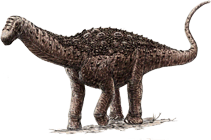
Pronunciation: SOH-ro-PO-duh
Author: Marsh
Year: 1878
Meaning: Lizard feet (see etymology)
Locomotion: Quadrupedal (four legs)
Synonyms:
Opisthocoelia (Owen, 1860),
Cetiosauria (Seeley, 1870),
Diplodocia (Tornier, 1913)
Opisthocoelia (Owen, 1860),
Cetiosauria (Seeley, 1870),
Diplodocia (Tornier, 1913)
[Sereno 2005]Definition
The most inclusive clade containing Saltasaurus loricatus but not Jingshanosaurus xinwaensis and Mussaurus patagonicus.
About
Sauropoda evolved from Triassic-aged saurischian stock — medium-sized, herbivorous, mostly bipedal ancestors testing the possibilities of long necks and expanding guts. These first sauropodomorphs — Plateosaurus and their kin — sketch only the faintest outline of what is to come: a deepening ribcage, a shift toward bulk-feeding, and the first hints of limbs preparing to trade agility for strength. By the Early Jurassic, the transformation is unmistakable: true sauropods appear in the fossil record already leaning into quadrupedality, already pushing their bodies toward sizes no land animal had attempted before. Their early evolution reads like an arms race against gravity itself — a steady escalation of scale, structure, and ambition, with every innovation buying another metre of reach, another increment of bulk, another foothold in a world built for giants.
Sauropods are defined by scale — not merely in their dimensions, but in their evolutionary audacity. Their necks stretch into improbable spans; their vertebrae become latticed cathedrals of bone and air; their limbs thicken into columns built to shoulder astonishing loads. Within this vast clade, lineages diverge into their own experiments: diplodocoids with their horizontal necks and whip-tails; macronarians lifting their skulls toward the canopy; titanosaurs, sometimes lightly armoured and remarkably adaptable, ranging across every continent. Despite their enormity, these animals are not the sluggish reptiles of outdated imagery. They grow rapidly, breathe through extensive air-sac systems that lighten their frames, and maintain physiologies more active than the traditional reptilian stereotype allows. Their diversity reveals a lineage continually refining the mechanics of gigantism, constantly testing how far a vertebrate body can be pushed before the architecture yields.
Their zenith arrives in the Late Jurassic and Early Cretaceous, when sauropods dominate herbivore guilds across multiple continents. Forests, floodplains, and fern-prairies all bear the imprint of their feeding. Their decline is uneven — diplodocoids disappear earlier, while titanosaurs persist, widespread and resilient, until the final hours of the Cretaceous. The K–Pg extinction ends their reign, but not their legacy. They remain the largest land animals ever to walk the Earth and the most extreme expressions of vertebrate engineering, leaving a fossil record that continues to reshape our understanding of growth, physiology, and biomechanics. Sauropoda is the lineage that dared to test the limits of terrestrial life — and, for a time, succeeded beyond imagination.
Click here to search Dinochecker for sauropods.
Etymology
Sauropoda is derived from the Greek "sauros" (lizard) and "pod-" (foot), based on O.C. Marsh's assumption that sauropod feet were "plantigrade" (toe to heel, flat to the ground) with splayed toes like those of a lizard.
Surprisingly for such rotund creatures, sauropods actually walked on their tippy-toes, even more so than modern elephants.
Relationships
References
• Buffetaut E, Suteethorn V, Cuny G, Haiyan Tong H, Le Loeuff J, Khansubha S and Jongautchariyakul S (2000) "The earliest known sauropod dinosaur". Nature, 407(6800): 72–74. DOI: 10.1038/35024060
• Upchurch P, Barrett PM and Dodson P (2004) "Sauropoda". In Weishampel, Dodson and Osmólska (eds.) "The Dinosauria: Second Edition".
• Wilson JA (2002) "Sauropod dinosaur phylogeny:
critique and cladistic analysis". Zoological Journal of the Linnean Society, 136: 217–276
• Curry Rogers KA and Wilson JA (2005) "The Sauropods: Evolution and Paleobiology".
• Tidwell V and Carpenter K (2005) "Thunder Lizards: The Sauropodomorph Dinosaurs".
• Taylor MP (2010) "Sauropod dinosaur research: a historical review". In Moody, Buffetaut, Martill and Naish (eds.) "Dinosaurs and other extinct saurians: a historical perspective".
• Klein N (2011) "Biology of the Sauropod Dinosaurs: Understanding the Life of Giants".
• Sander PM, Christian A, Clauss M, Fechner R, Gee CT, Griebeler E-M, Gunga H-C, Hummel J, Mallison H, Perry SF et al. (2011) "Biology of the sauropod dinosaurs: the evolution of gigantism". Biological Reviews, 86(1): 117–155. DOI: 10.1111/j.1469-185X.2010.00137.x.
• Sellers WI, Margetts L, Coria RAB and Manning PL (2013) "March of the Titans: The Locomotor Capabilities of Sauropod Dinosaurs". PLOS ONE, 8(10): e78733. DOI: 10.1371/journal.pone.0078733.
• Hallett M and Wedel M (2016) "The Sauropod Dinosaurs: Life in the Age of Giants".
• Molina-Pérez R and Larramendi A (2020) "Encyclopedia of Dinosaurs: The Sauropods" [Dinosaur Facts and Figures: The Sauropods and Other Sauropodomorphs].
• Stevens KA, Ernst S and Marty D (2022) "Coupling length: a generalized gleno-acetabular distance measurement for interpreting the size and gait of quadrupedal trackmakers". Swiss Journal of Geosciences, 115(18): 1-27.
DOI: 10.1186/s00015-022-00418-9
• Otero A, Carballido JL and Pol D (2022) "South American Sauropodomorph Dinosaurs: Record, Diversity and Evolution".
• Sander PM (2023) "Sauropods". Current Biology, 33(2): R52-R58.
DOI: 10.1016/j.cub.2022.12.024.
• Lei R, Tschopp E, Hendrickx C, Wedel MJ, Norell MA and Hone DWE (2023) "Bite and tooth marks on sauropod dinosaurs from the Morrison Formation". PeerJ, 11: e16327.
DOI: 10.7717/peerj.16327.


