






Pronunciation: DAY-mo-no-SOR-us
Meaning: Evil spirit lizard
Author/s: Sues et al. (2011)
Synonyms: None known
First Discovery: New Mexico, USA
Acta Ordinal: #787
Daemonosaurus chauliodus
After the discovery of Chindesaurus, Tawa, and hundreds of other small theropod skeletons at Ghost Ranch helped cement Coelophysis as a valid critter at the expense of Rioarribasaurus, you may think that the area had been milked dry of diddy dinosaurs. Not so. Daemonosaurus was found smack-bang in the middle of "Coelophysis quarry", no less, but some rather distinct features proved that this dog-sized carnivore was new to science.
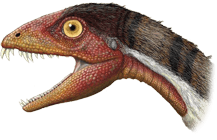
Discovered by a team from the Carnegie Museum way back in 1981, mingled with some remains of Coelophysis, the 5.5-inch-long skull of Daemonosaurus is narrow and relatively deep, with a short, blunt snout and huge eye sockets. Those features alone set it apart from all of the area's other small theropods—and indeed most theropods from anywhere else. But its most outstanding feature, quite literally, is its teeth. An upper jaw packed with large, forward-slanted front teeth prompted the specific name chauliodus, derived from the Greek word for "buck-toothed". But they weren't just slanted, they were also sharp and pointed, suggesting Daemonosaurus was all business when the dinner bell rang.
According to Hans-Dieter Sues, curator of vertebrate palaeontology at the Smithsonian Museum of Natural History and lead author of Daemonosaurus, the features of its skull and the presence of cavities on some neck vertebrae (the only bits currently known) plonk it right alongside Tawa as an evolutionary bridge—somewhere between the primitive South American hererrasaurids and Eoraptor (which may yet turn out to be a sauropodomorph) on one side, and the advanced neotheropods on the other. However, because Daemonosaurus is known only from a body-less skull which has a stubby snout and huge eyes reminiscent of juveniles that rely on cuteness for care, while the same-age-same-place Chindesaurus is known only from the skull-less body of a full-grown adult, some experts are far from convinced that the pair represent two distinct species.
Discovered by a team from the Carnegie Museum way back in 1981, mingled with some remains of Coelophysis, the 5.5-inch-long skull of Daemonosaurus is narrow and relatively deep, with a short, blunt snout and huge eye sockets. Those features alone set it apart from all of the area's other small theropods—and indeed most theropods from anywhere else. But its most outstanding feature, quite literally, is its teeth. An upper jaw packed with large, forward-slanted front teeth prompted the specific name chauliodus, derived from the Greek word for "buck-toothed". But they weren't just slanted, they were also sharp and pointed, suggesting Daemonosaurus was all business when the dinner bell rang.
According to Hans-Dieter Sues, curator of vertebrate palaeontology at the Smithsonian Museum of Natural History and lead author of Daemonosaurus, the features of its skull and the presence of cavities on some neck vertebrae (the only bits currently known) plonk it right alongside Tawa as an evolutionary bridge—somewhere between the primitive South American hererrasaurids and Eoraptor (which may yet turn out to be a sauropodomorph) on one side, and the advanced neotheropods on the other. However, because Daemonosaurus is known only from a body-less skull which has a stubby snout and huge eyes reminiscent of juveniles that rely on cuteness for care, while the same-age-same-place Chindesaurus is known only from the skull-less body of a full-grown adult, some experts are far from convinced that the pair represent two distinct species.
(Buck-toothed evil spirit lizard)Etymology
Daemonosaurus is based on the Greek words "daimon" (evil spirit, because it was found at Ghost Ranch) and "sauros" (lizard). The species epithet, chauliodus, is derived from the Greek word for "buck-toothed" and refers to the species' big, slanted, front teeth.
Discovery
The remains of Daemonosaurus were discovered in block C-4-81 at Coelophysis (Whitaker) Quarry in the "siltstone member" of the Chinle Formation, Ghost Ranch, 20 km northwest of Abiquiú, Rio Arriba County, New Mexico, by a team of scientists led by the Smithsonian Institution in 1981.
The holotype (CM 76821) is a nearly complete but crushed skull with lower jaw, and some neck vertebrae with ribs.


