




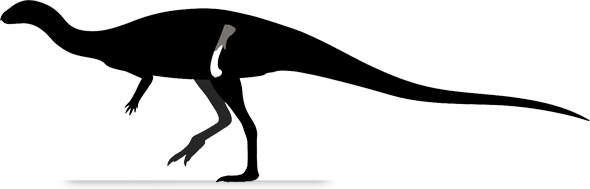
Pronunciation: TEE-yet-uh-SOR-uh
Meaning: Tieta lizard
Author/s: Bandeira et al. (2024)
Synonyms: None known
First Discovery: Bahia State, Brazil
Acta Ordinal: #1158
Tietasaura derbyiana
Collected in 1906 by Joseph Mawson near Plataforma Station in Salvador, Bahia, the lone fossil of Tietasaura derbyiana—half of a left thigh—was shipped to the Natural History Museum, London, where it remained unstudied for more than a century. Within the museum’s physical collections, the bone was long labelled as Hyposaurus sp., reflecting early assumptions that the Marfim Formation’s vertebrates were mostly crocodyliforms, while the museum’s online fossil database instead listed it as Sarcosuchus hartti, a different crocodyliform entirely. The misidentifications continued until a 2024 re-description finally recognized the bone as belonging to a small elasmarian ornithopod, marking the first confirmed ornithischian dinosaur represented by actual skeletal fossils—rather than footprints or teeth—from Brazil.
(Derby's Tieta lizard)Etymology
Tietasaura is derived from "Tieta" (a nickname for Antonieta in Portuguese) and the Greek "saura" (the feminine form of "sauros", meaning "lizard"). The name honours the main character from the novel "Tieta do Agreste" by the famous author Jorge Amado, who was born in Bahia and lived in Salvador City. Antonieta also means "priceless", alluding to the value of Tietasaura as the first named ornithischian dinosaur from Brazil.
The species epithet, derbyiana, honours Orville A. Derby (1851–1915), founder and first director of the Brazilian Mineralogical and Geological Commission (Serviço Geológico e Mineralógico do Brasil, nowadays SGB), and former director of the National Museum of Rio de Janeiro (MN). Derby was one of the pioneers of palaeontology in the Recôncavo Basin, and fought valiantly for the scientific progress of the Brazilian geosciences, despite all of the tragedies in his life and the blatant lack of governmental support. ZooBank registry: urn:lsid:zoobank.org:act:814725BB-A522-465F-975D-1755A11C3956.
Discovery
The remains of Tietasaura were discovered in the Marfim Formation (Ilhas Group, Recôncavo Basin) at "Locality 3" on a beach near the Plataforma Station, Salvador City, Bahia State, Brazil, by Joseph Mawson in 1906.The holotype (NHM-PV R.3424) is a partial left thigh bone.
Preparator
Arthur Smith Woodward.


