






Pronunciation: tal-uh-ROOR-us
Meaning: Basket tail
Author/s: Maleev (1952)
Synonyms: None known
First Discovery: Dornogovi, Mongolia
Acta Ordinal: #196
Talarurus plicatospineus
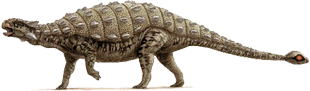
Talarurus is a member of ankylosauria - the armoured battalion of dinosaurs, and if ankylosaurs were real soldiers Talarurus would be a Hoplite. Its neck, back and flanks were entirely covered in thick armour plates conjoined into bony shields. In fact, it was so well-armoured that even its armour was armoured, and each of its bony, boat-shaped armour plates was adorned with pleated spines for which Talarurus plicatospineus ("plicated spines") was named.
As well as being well armoured it was also well-armed as the end of its tail was carrying a mace-like club made from a series of fused bones, though it was relatively modest compared to the real big-hitting ankylosaurs. Still, the tail itself was possibly 25 vertebrae long and re-inforced with a series of interwoven bony struts for both strength and flexibility, and a carnivore-crippling blow could be delivered with a single swish.
Often referred to as a hippopotamus-size dinosaur due to a more barrel-shaped body than its low-slung, wide-load brethren, the body and tail of Talarurus were not the only parts that were armoured. Although fairly small, flat and narrow compared to most other ankylosaurs, its skull, 24Â centimetres long and 22Â cm wide, was similarly fortified with thickened bones which, unfortunately, didn't leave much room for a brain.
As well as being well armoured it was also well-armed as the end of its tail was carrying a mace-like club made from a series of fused bones, though it was relatively modest compared to the real big-hitting ankylosaurs. Still, the tail itself was possibly 25 vertebrae long and re-inforced with a series of interwoven bony struts for both strength and flexibility, and a carnivore-crippling blow could be delivered with a single swish.
Often referred to as a hippopotamus-size dinosaur due to a more barrel-shaped body than its low-slung, wide-load brethren, the body and tail of Talarurus were not the only parts that were armoured. Although fairly small, flat and narrow compared to most other ankylosaurs, its skull, 24Â centimetres long and 22Â cm wide, was similarly fortified with thickened bones which, unfortunately, didn't leave much room for a brain.
(Basket-tail with folded spines)Etymology
Talarurus is derived from the Greek "talaros" (wicker basket) and "oura" (tail). Some sources assume it was named for a wicker basket-like tail club but "basket tail" refers to its entire tail; fortified with interlaced bony struts that roughly resembles the weave used to make wicker baskets. Its tail club is formed from fused bones!
The species epithet, plicatospineus, is derived from the Latin "plicatura" (folded) and "spineus" (thorny), referring to the corrugated spines on the surface of its armour plates.
Discovery
The remains of Talarurus were discovered in the Bayn Shire Formation (aka Bayn Shiree, Bayan Shiree Svita, Bayn Shireh Svita, Baynshirenskaya), Dornogovi Aimag (Province), Mongolia, by the Russian Academy of Sciences in 1948. The holotype (PIN N 557/91, housed at the Palaeontological Institute in Moscow) is a partial skull.


