




Pronunciation: ko-RITH-o-SOR-us
Meaning: Helmet lizard
Author/s: Brown (1914)
Synonyms: See below
First Discovery: Alberta, Canada
Acta Ordinal: #895
Corythosaurus casuarius
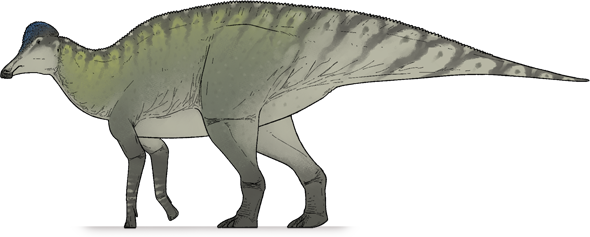
Corythosaurus is one of the large duck-billed dinosaurs known as lambeosaurines - the hadrosaurs with headgear, typified by their rather elaborate head decor. To be more specific, Corythosaurus is one of the helmet-crested Corythosaurini and its crest, resembling the helmets worn by the Romans of Corinth, gave rise to this unusual creature's name. But it was more than just a fashion accessory.
Because of exceptional preservation, we know that its crest contained two "sacks" that funnelled air from each nostril of an unusually short snout into one central chamber then onward into the respiratory system. Scientists speculate that this chamber acted as a resonator to amplify bellows for communication purposes, and CT scans revealed an inner ear structure capable of detecting and deciphering said calls, and a brain that was large enough to act on the information received.
Smelling, on the other hand, may have been a problem. The olfactory bulb (the part of the brain that deals with scent) was tiny, at least compared to the cerebrum (the part of the brain devoted to higher-level functions). Apparently, Corythosaurus weren't as dumb as you might think and were, in fact, communicating in quite a sophisticated manner. As for smelling? Well, who wants a sensitive nose when your family are powered by fermenting foliage?
In 1916, Charles H. and Levi Sternberg discovered two specimens of Corythosaurus which were loaded onto SS Mount Temple—one of the ships that responded to... or possibly ignored... the Titanic's distress signals on 14 April 1912—bound for Arthur Smith Woodward at the British Museum's Natural History Department, but they never made it. The M.T. was scuttled by SMS Möwe (charading as a harmless cargo ship) and sent to the bottom of the North Atlantic. But the hadrosaurids had the last laugh when Bristol Beaufighters of the British Royal Airforce bombed and sank the Möwe while it hid from a storm off the coast of Norway on April 7th, 1945.
Because of exceptional preservation, we know that its crest contained two "sacks" that funnelled air from each nostril of an unusually short snout into one central chamber then onward into the respiratory system. Scientists speculate that this chamber acted as a resonator to amplify bellows for communication purposes, and CT scans revealed an inner ear structure capable of detecting and deciphering said calls, and a brain that was large enough to act on the information received.
Smelling, on the other hand, may have been a problem. The olfactory bulb (the part of the brain that deals with scent) was tiny, at least compared to the cerebrum (the part of the brain devoted to higher-level functions). Apparently, Corythosaurus weren't as dumb as you might think and were, in fact, communicating in quite a sophisticated manner. As for smelling? Well, who wants a sensitive nose when your family are powered by fermenting foliage?
In 1916, Charles H. and Levi Sternberg discovered two specimens of Corythosaurus which were loaded onto SS Mount Temple—one of the ships that responded to... or possibly ignored... the Titanic's distress signals on 14 April 1912—bound for Arthur Smith Woodward at the British Museum's Natural History Department, but they never made it. The M.T. was scuttled by SMS Möwe (charading as a harmless cargo ship) and sent to the bottom of the North Atlantic. But the hadrosaurids had the last laugh when Bristol Beaufighters of the British Royal Airforce bombed and sank the Möwe while it hid from a storm off the coast of Norway on April 7th, 1945.
Etymology
Corythosaurus is derived from the Greek koryth (helmet) and sauros (lizard) because Barnum Brown thought its head-crest resembled a Corinthian helmet.The species epithet, casuarius, is derived from "kesuari" (the Malay word for a Cassowary). Apparently old B.B. couldn't decide if the headcrest was closer to a helmet or the casque of a flightless bird from New Guinea, so he used both.
Discovery
Whilst exploring the Judith River Formation at Steveville, Red Deer River, Alberta, Canada in 1911, Barnum Brown came up trumps with the holotype (AMNH 5240) of Corythosaurus; an almost complete skeleton with clearly visible impressions of scaly skin which more than made up for its missing tail and bits of forelimb. It was initially described by Brown in 1914, the same year as he and Peter Kaisen found a second specimen (AMNH 5338). A more in-depth description of both specimens arrived in 1916.
Corythosaurus excavatus (Gilmore, 1923)
Stephanosaurus intermedius (Parks, 1923)
Tetragonosaurus erectofrons (Parks, 1931): Rejected name. Transferred to Procheneosaurus erectofrons by Lull and Wright in 1942
Corythosaurus bicristatus (Parks, 1935)
Corythosaurus brevicristatus (Parks, 1935)
Corythosaurus frontalis (Parks, 1935)


