





Pronunciation: BRAH-vah-SOR-us
Meaning: Laguna Brava lizard
Author/s: Hechenleitner et al. (2020)
Synonyms: None known
First Discovery: La Rioja, Argentina
Acta Ordinal: #1058
Bravasaurus arrierosorum
(The Arrieros' Laguna Brava Lizard)Etymology
Bravasaurus is derived from "Laguna Brava" (the lake for which the Laguna Brava Provincial Park is named) and the Greek "sauros" (lizard).
The species epithet, arrierosorum,
honours the Arrieros (colloquially known as "muleteers" or "muleskinners"): A person or people who transport goods using pack animals, in this case, the folk who drove cattle across the Andes in the 19th century.
ZooBank registry: urn:lsid:zoobank.org:act:84B7ECE6-60B4-4324-B983-CD86C8952E8A.
Discovery
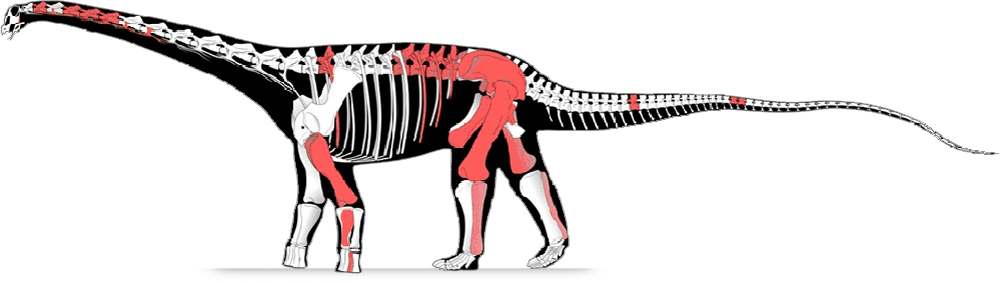
The remains of Bravasaurus were recovered from sandstone beds 34 m above the base of the Ciénaga del Río Huaco Formation at Quebrada de Santo Domingo (QSD), in the Andes of La Rioja, northwestern Argentina. The Quebrada de Santo Domingo locality is renowned for its abundant fossilized sauropod eggs and ranks among the largest documented dinosaur nesting sites worldwide.The holotype (CRILAR-Pv 612) consists of two skull bones, four neck, five back, and three tail vertebrae, a few ribs and three chevrons, a left upper arm, a fragmentary lower arm, a hand bone (metacarpal IV), a partial pelvic girdle, a left thigh, and both calf bones. The paratype (CRILAR-Pv 613) consists of an isolated tooth, a hip bone (right ilium), a right thigh, and associated ribs.
Preparators
Sergio de la Vega, Carlos Bustamante, Julia Desojo, Hernán Aciar, Leonel Acosta, Marcelo Miñana, Victoria Fernandez Blanco, Tomaz Melo, Jimena Trotteyn, Mariano Larrovere, Marcos Macchioli, Tatiana Sánchez, Gabriel Hechenleitner, Eugenio Sanchez, and Walter Bustamante.


