




Pronunciation: a-KILL-oh-BAH-tor
Meaning: Achilles Hero
Author/s: Perle, Norell and Clark (1999)
Synonyms: None known
First Discovery: Burkhant, Mongolia
Acta Ordinal: #452
Achillobator giganticus
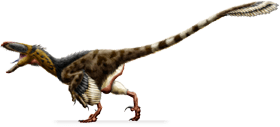
Although discovered by a joint expedition to Mongolia way back in 1989, Achillobator, with its serrated teeth, long stiff tail and second toe "killing claws", sports feats of engineering genius typical of American dromaeosaurids or "raptors". It was somewhat chunkier than its more famous relatives, possibly twice the size of Deinonychus if its half meter long femur is anything to go by. But a weird combination of features, hitherto unseen in a single critter, prompted many experts to scream "chimera" from the hilltops.
A large skull, similar in proportion to carnosaurs (the theropods closer to Allosaurus), rustic hips with a large, boot-ended, downwards-pointing pubis bone (dromaeosaurids mostly have a backwards-pointing pubis with a small boot, if any), short and robust neck vertebrae that are not uncommon in oviraptorosaurs, and proportionately weird-for-a-dromaeosaurid hind legs were all crying out to be described in detail. But after a patient decade-long wait all we got was a rough-around-the-edges preliminary draft that was "accidentally" published in an obscure Mongolian journal. And two of the three authors, Mark Norell and James Clark, were blissfully unaware of it.
Often illustrated with a speculative coat of feathers, Achillobator was found semi-articulated so at least some of its bits were joined where they should be and they were of the same color and state of preservation which speaks volumes for the validity of the find. What's less certain, is whether the "Achilles hero" was hunting the contemporary club-tailed ankylosaur Talarurus for lunch and being as heroic as the name implies, or if a pack of them were terrorizing something a lot more defenceless, as only a single specimen has been found thus far.
A large skull, similar in proportion to carnosaurs (the theropods closer to Allosaurus), rustic hips with a large, boot-ended, downwards-pointing pubis bone (dromaeosaurids mostly have a backwards-pointing pubis with a small boot, if any), short and robust neck vertebrae that are not uncommon in oviraptorosaurs, and proportionately weird-for-a-dromaeosaurid hind legs were all crying out to be described in detail. But after a patient decade-long wait all we got was a rough-around-the-edges preliminary draft that was "accidentally" published in an obscure Mongolian journal. And two of the three authors, Mark Norell and James Clark, were blissfully unaware of it.
Often illustrated with a speculative coat of feathers, Achillobator was found semi-articulated so at least some of its bits were joined where they should be and they were of the same color and state of preservation which speaks volumes for the validity of the find. What's less certain, is whether the "Achilles hero" was hunting the contemporary club-tailed ankylosaur Talarurus for lunch and being as heroic as the name implies, or if a pack of them were terrorizing something a lot more defenceless, as only a single specimen has been found thus far.
Giant Achilles HeroEtymology
Achillobator is derived from "Achilles" (the Greek semi-immortal with a famous heel, which is a reference to the huge achilles tendon needed to operate its "killing" claws), and the Mongolian "bator" (hero). The species epithet, giganticus (ji-GAN-ti-kuhs), means "Gigantic" in Latin, and refers to Achillobator's size, which exceeds that of most other dromaeosaurids.
Discovery
The remains of Achillobator were discovered at "Burkhant" (quarry) in the Baynshiree Formation, southwest of the village of Dzun Bayan, near Khongli Tsav, Dornogovi (East Gobi), Southeast Mongolia, during a Mongolian and Russian field expedition in 1989. They were excavated by Burkhant, and the quarry was named in his honour.
The holotype (FR.MNUFR-15) includes a fragment of the upper jaw with teeth, vertebrae, ribs, and bones from the shoulder, pelvis, forelimbs and hindlimbs, fingers and toes.


