





Pronunciation: bwee-tree-rap-tor
Meaning: Vulture nest plunderer
Author/s: Makovicky et al. (2005)
Synonyms: None known
First Discovery: Patagonia, Argentina
Acta Ordinal: #567
Buitreraptor gonzalezorum
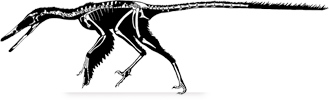
Buitreraptor is quite different from other dromaeosaurids. Not only is it lacking the typical serrations on its many small and well-spaced teeth, but its thin-snouted skull is about 25% longer than its thigh bone. And more longness is yet to come.
Compared to its closest relatives the body of Buitreraptor was lightweight, shallow and long, its arms were long, and its long hands had three fingers that were all essentially the same length, but still long. Fortunately for Patagonian Cretaceous herbivores, this proportionate longness belonged to a critter no bigger than a turkey and... wait for it... its claws were short!
Buitreraptor is one of only a handful of "raptors" known from the southern continents and the most completely known unenlagiine from anywhere. Its holotype is an exceptionally handsome specimen if rumours are to be believed (it has yet to be fully prepared) despite the attention of a gnawing scavenger that took a shine to some of its bones.
Compared to its closest relatives the body of Buitreraptor was lightweight, shallow and long, its arms were long, and its long hands had three fingers that were all essentially the same length, but still long. Fortunately for Patagonian Cretaceous herbivores, this proportionate longness belonged to a critter no bigger than a turkey and... wait for it... its claws were short!
Buitreraptor is one of only a handful of "raptors" known from the southern continents and the most completely known unenlagiine from anywhere. Its holotype is an exceptionally handsome specimen if rumours are to be believed (it has yet to be fully prepared) despite the attention of a gnawing scavenger that took a shine to some of its bones.
(González brother's Vulture-Roost Plunderer)
Etymology
Buitreraptor is derived from the Spanish "Buitrera" (vulture roost), in reference to its place of discovery (see below), and the Latin "raptor" (plunderer, robber, snatcher or thief). The species epithet, gonzalezorum, honours brothers Fábian and Jorge González who organised the excavation and preparation of the fossils.
Discovery
The first fossils of Buitreraptor were discovered at La Buitrera in the Candeleros Formation (formerly known as the Candeleros Member of the Rio Limay Formation), in north-west RÃo Negro Province, Patagonia, close to the southern
shore of the Ezequiel Ramos-MexÃa Lake. The Candeleros is the oldest formation in the Neuquen Group. La Buitrera is a hotspot for roosting vultures and literally means "vulture roost" in Spanish.The holotype (MPCA 245) is an almost complete skeleton including a partial skull.


