




Pronunciation: suh-VAN-uh-SOR-us
Meaning: Savanna lizard
Author/s: Poropat et al. (2016)
Synonyms: None known
First Discovery: Queensland, Australia
Acta Ordinal: #947
Savannasaurus elliottorum
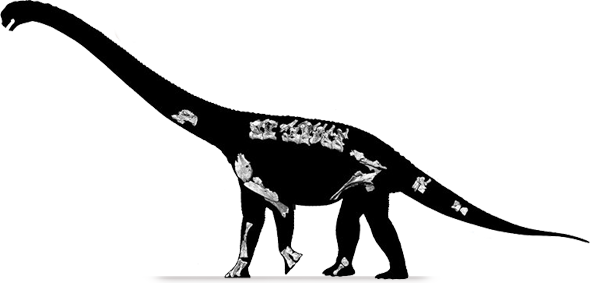
Discovered in 2005 on Belmont Station near Winton by David Elliott, Savannasaurus elliottorum currently represents the most complete sauropod ever recovered from Australia. The holotype (AODF 660), affectionately known as "Wade", preserves a broad sweep of the body and limbs, revealing a titanosaur that is both familiar in outline and strikingly specialized.
A basal member of Titanosauria, Savannasaurus sits close to the base of the family tree, sharing ancestry with forms such as Diamantinasaurus while still holding onto some older, more primitive features. Its vertebrae, for example, lack the hyposphene–hypantrum bracing seen in more derived titanosaurs, yet its limbs and girdles show the robust proportions characteristic of the group.
The most distinctive feature of Savannasaurus is its exceptionally broad torso and pelvis, which produced a wide-gauge stance that is now recognized as a hallmark adaptation among titanosaurs inhabiting muddy areas. This is not a minor anatomical curiosity: the hips span more than a metre across and the body is barrel-shaped and Hippopotamus-like, while the spine shows greater mobility and the robust limb bones—particularly the upper arms and tall ankles—are built to spread weight across a broad base. These features combined likely helped the animal stay stable and reduced the risk of it sinking into the boggy floodplains that covered the Winton region during the mid-Cretaceous.
Although only medium-sized by titanosaur standards, Savannasaurus still reached a respectable 12–15 metres in length and may have tipped the scales at around 15-to-20 tons. It lived alongside Diamantinasaurus, the predator Australovenator, and a diverse mix of freshwater and land animals. Bite marks from Australovenator found on Savannasaurus bones suggest scavenging at minimum, offering a rare glimpse into the food web of this ancient ecosystem.
A basal member of Titanosauria, Savannasaurus sits close to the base of the family tree, sharing ancestry with forms such as Diamantinasaurus while still holding onto some older, more primitive features. Its vertebrae, for example, lack the hyposphene–hypantrum bracing seen in more derived titanosaurs, yet its limbs and girdles show the robust proportions characteristic of the group.
The most distinctive feature of Savannasaurus is its exceptionally broad torso and pelvis, which produced a wide-gauge stance that is now recognized as a hallmark adaptation among titanosaurs inhabiting muddy areas. This is not a minor anatomical curiosity: the hips span more than a metre across and the body is barrel-shaped and Hippopotamus-like, while the spine shows greater mobility and the robust limb bones—particularly the upper arms and tall ankles—are built to spread weight across a broad base. These features combined likely helped the animal stay stable and reduced the risk of it sinking into the boggy floodplains that covered the Winton region during the mid-Cretaceous.
Although only medium-sized by titanosaur standards, Savannasaurus still reached a respectable 12–15 metres in length and may have tipped the scales at around 15-to-20 tons. It lived alongside Diamantinasaurus, the predator Australovenator, and a diverse mix of freshwater and land animals. Bite marks from Australovenator found on Savannasaurus bones suggest scavenging at minimum, offering a rare glimpse into the food web of this ancient ecosystem.
(The Elliott's savanna lizard)Etymology
Savannasaurus is derived from the Taino Spanish "zavana" (savanna), in reference to the countryside in which the specimen was found, and the Greek "sauros" (lizard). The species epithet, elliottorum, honours the Elliott family for their ongoing contributions to Australian palaeontology.
Discovery
The first remains of Savannasaurus were discovered in the Winton Formation at the "Ho-Hum Site" (AODL—Australian Age of Dinosaurs Locality—82), Belmont sheep station, Winton, Queensland, Australia, by grazier David Elliot while mustering his sheep in 2005.
The holotype (AODF 660, nicknamed "Wade") consists of one neck vertebra, several neck ribs, eight back vertebrae, several back ribs, four hip vertebrae, five partial tail vertebrae, a partial shoulder girdle, left and right breast plates, incomplete left and right upper arms, a partial lower arm (a shattered ulna and left radius), hand bones (right metacarpals I-V, left metacarpal IV), two finger bones, a partial hip (both pubes and ischia), a left ankle, a foot bone (right metatarsal III), and associated fragments.
Preparators
Staff from the Australian Age of Dinosaurs Natural History Museum, the Queensland Museum, and the University of Queensland.


