PROTATHLITIS
a spinosaurid theropod dinosaur from the Early Cretaceous of Spain.
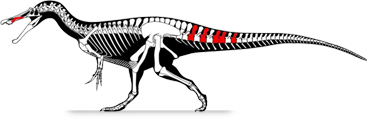
Pronunciation: pro-tath-LEE-tiss
Meaning: Champion
Author/s: Santos-Cubedo
et al. (
2023)
Synonyms: None known
First Discovery: Castellón province, Spain
Acta Ordinal: #1121
Protathlitis cinctorrensis
(Champion from Cinctorres)Etymology
Protathlitis means "champion" in Greek, in reference to the UEFA Europa League title won by Villarreal C.F. in 2021 and as a tribute to the club centenary celebrated in 2023. (Three of the authors who named
Protathlitis live in Villarreal,)
The
species epithet,
cinctorrensis (sink-toh-REN-sis), means "from
Cinctorres" in Latin.
ZooBank registry:
urn:lsid:zoobank.org:act:FDC6CE8E-D932-4A72-9C3A-DF797E32B539.
Discovery
The remains of
Protathlitis were discovered at the ANA site in the Arcillas de Morella Formation near the village of Cinctorres, 100 km northwest of Castellón de la Plana, Castellón province, Spain. The site was discovered in 1998 by the geologist Ramón Ortí, but it remained unexplored until 2002, when a team from the Institut de Paleontologia Miquel Crusafont from Sabadell (Barcelona) and the Grup Guix from Vila-real (Castellón) unearthed the first fossils.
The
holotype includes a fragment of tooth-bearing bone from the upper jaw (8ANA-109) and five tail vertebrae (3ANA83, 4ANA43, 4ANA69, 4ANA76, and 5ANA78). Referred material includes a tooth (4ANA-11) that was published by Suñer and Santos-Cubedo in 2008.
Estimations
Timeline:
Era: Mesozoic
Epoch: Early Cretaceous
Stage: Barremian
Age range: 129-121 mya
Stats:
Est. max. length: 6.5 meters
Est. max. hip height: 2.5 meters
Est. max. weight: ?
Diet: Piscivore
Protathlitis
cinctorrensis
References
• Weishampel DB, Barrett PM, Coria RA, Le Loeuff J, Xu X, Zhao X, Sahni A, Gomani EMP and Noto CR (2004) "Dinosaur Distribution". Page 590 in Weishampel, Dodson and Osmólska (eds.) "
The Dinosauria: Second Edition".
• Suñer M and Santos-Cubedo A (2008) "Dos dientes de terópodo del yacimiento ANA, Formación Arcillas de Morella (Aptiense, Cretácico Inferior, Cinctorres, Castellón)".
Stud. Geol. Salmant. 8: 27–39.
• Mateus O and Estraviz-López D (2022) "A new theropod dinosaur from the early cretaceous (Barremian) of Cabo Espichel, Portugal: Implications for spinosaurid evolution".
PLoS ONE, 17(2): e0262614.
• Santos-Cubedo A, de Santisteban C, Poza B and Meseguer S (2023) "
A new spinosaurid dinosaur species from the Early Cretaceous of Cinctorres (Spain)".
Scientific Reports 13: 6471
DOI: 10.1038/s41598-023-33418-2.
• Isasmendi E, Cuesta E, Díaz-Martínez I, Company J, Sáez-Benito P, Viera LI, Torices A and Pereda-Suberbiola P (2024) "Increasing the theropod record of Europe: a new basal spinosaurid from the Enciso Group of the Cameros Basin (La Rioja, Spain). Evolutionary implications and palaeobiodiversity".
Zoological Journal of the Linnean Society, 202(3): zlad193. DOI: 10.1093/zoolinnean/zlad193.
• Rauhut OWM, Canudo JI and Castanera D (2025) "Revision of the theropod dinosaur Camarillasaurus cirugedae from the Early Cretaceous (Barremian) of Teruel province, Spain".
Palaeontologia Electronica, 28(3): 1-67. DOI: 10.26879/1543.
Time stands still for no man, and research is ongoing. If you spot an error, or want to expand, edit or add a dinosaur, please use
this form. Go
here to contribute to our FAQ.
All dinos are GM free, and no herbivores were eaten during site construction!
To cite this page:
Atkinson, L.
"
PROTATHLITIS :: from DinoChecker's dinosaur archive".
‹
http://www.dinochecker.com/dinosaurs/PROTATHLITIS›. Web access: 09th Sep 2026.