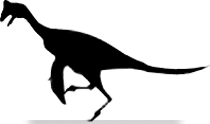
an omnivorous oviraptorid theropod dinosaur from the Late Cretaceous of China.
Pronunciation: kan-jo-SOR-us
Meaning: Ganzhou Lizard
Author/s: Wang
et al. (
2013)
Synonyms: None known
First Discovery: Jiangxi Province, China
Acta Ordinal: #857
Ganzhousaurus nankangensis
Despite representing a relatively small area, the upper Cretaceous deposits that span Mongolia's Gobi Desert to Inner Mongolia of China is a beacon for oviraptorosaur discoveries, having yielded at least nine separate and distinct species as of 2017. More impressively, Ganzhou City alone has produced six species, plus indeterminate nests, eggs, and embryos, which is no mean feat considering heavy quarrying in the area for building materials left many specimens smashed to smithereens. But Lady Luck shone on
Banji long,
Jiangxisaurus ganzhouensis,
Nankangia jiangxiensis,
Huanansaurus ganzhouensis,
Tongtianlong limosus and
Ganzhousaurus nankangensis, which, although incomplete, do include overlapping skeletal parts for comparison.
(Ganzhou lizard from Nankang)Etymology
Ganzhousaurus is derived from "Ganzhou" (for Ganzhou City) and the Greek "sauros" (lizard).
The
species epithet,
nankangensis, is derived from "Nankang" (for Nankang County) and the Latin "-ensis" (from, place of origin).
Discovery
The remains of
Ganzhousaurus were discovered in the Nanxiong Formation near Ganzhou City, Nankang County, Jiangxi Province, southern China, by a fossil dealer who is not willing to reveal his identity.
The
holotype (SDM 20090302) is a partial skeleton including part of the lower jaw, some tail vertebrae, fragments of the pelvis and limbs, and a foot.
An unnamed specimen housed in the Nanxiong Museum (Nanxiong Museum No. E-1), with a lower jaw length to height ratio greater than any other known oviraptorid, resembles
Ganzhousaurus nankangensis in some respects. It comprises an incomplete lower jaw, two neck vertebrae, some articulated back vertebrae, and an incomplete right foot, and it may belong to Ganzhousaurus, but hasn't yet been fully described.
• Lü JC (2005) "Oviraptorid Dinosaurs from Southern China".
Geological Publishing House, Beijing, 1-208
• Xu X and Han FL (2010) "
A new Oviraptorid dinosaur (Theropoda: Oviraptorosauria) from the upper Cretaceous of China".
 Vertebrata Palasiatica, 48(1): 11-18. [Banji long.]
• Wang S, Sun C, Sullivan C and Xu X (2013) "
A new oviraptorid (Dinosauria: Theropoda) from the Upper Cretaceous of southern China".
Zootaxa, 3640(2): 242-251. DOI: 10.11646/zootaxa.3640.2.7.
• Wei XF, Pu HY, Xu L, Liu D and Lü JC (2013) "A new oviraptorid dinosaur (Theropoda: Oviraptorosauria) from the Late Cretaceous of Jiangxi Province, southern China".
Acta Geologica Sinica, 87: 899-904. [Jiangxisaurus ganzhouensis.]
• Lü JC, Yi LP, Zhong H and Wei XF (2013) "A new oviraptorosaur (Dinosauria: Oviraptorosauria) from the Late Cretaceous of Southern China and its paleoecological implications".
PLoS ONE, 8(11): e80557. DOI: 10.1371/journal.pone.0080557. [Nankangia jiangxiensis.]
• Junchang Lü, Hanyong Pu, Kobayashi Y, Li Xu, Chang H, Shang Y, Liu D, Lee Y-N, Kundrát M and Shen C (2015) "A new oviraptorid Dinosaur (Dinosauria: Oviraptorosauria) from the Late Cretaceous of Southern China and its paleobiogeographical implications".
Scientific Reports, 5: 11490. DOI: 10.1038/srep11490. [Huanansaurus ganzhouensis.]
• Lü J, Chen R, Brusatte SL, Zhu Y and Shen C (2016)
"A Late Cretaceous diversification of Asian oviraptorid dinosaurs: evidence from a new species preserved in an unusual posture".
Scientific Reports, 6(1): 35780. DOI: 10.1038/srep35780. [Tongtianlong limosus.]
Time stands still for no man, and research is ongoing. If you spot an error, or want to expand, edit or add a dinosaur, please use
this form. Go
here to contribute to our FAQ.
All dinos are GM free, and no herbivores were eaten during site construction!
To cite this page:
Atkinson, L.
"
GANZHOUSAURUS :: from DinoChecker's dinosaur archive".
‹
http://www.dinochecker.com/dinosaurs/GANZHOUSAURUS›. Web access: 09th Sep 2026.