




Pronunciation: ep-ih-KI-roh steh-NO-teez
Meaning: Above Chirostenotes
Author/s: Sullivan et al. (2011)
Synonyms: None known
First Discovery: Alberta, Canada
Acta Ordinal: #763
Epichirostenotes curriei
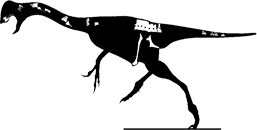
The remains that would become Epichirostenotes were discovered in two blocks hauled from Alberta's Horseshoe Canyon Formation way back in 1923 but made it all the way to 1972 virtually un-noticed. Then Dale Russell, following the lead of discoverer G.E. Lindblad, listed its remains (ROM 43250) as the property of an unidentified ornithomimid, even though they were still completely encased in plaster field jackets at the time.
In 1988, Hans-Dieter Sues revisited ROM 43250 and was privy to a brief and partial unwrapping, and realised that its meagre, crushed, and distorted remains had been misidentified. They were not the property of an ornithomimid as previously thought, but an oviraptorosaur, and this was such ground-shaking news that the fossils were promptly re-wrapped and put back into storage, only to reappear nine years later assigned to Chirostenotes pergracilis.
Robert Sullivan, Steven Jasinski, and Mark van Tomme compared ROM 43250 with known oviraptorosaur species in 2011, concluding once again that it had been misidentified. Its ischium (a hip bone) is choc-a-bloc with unique features, and it belongs to a body around 20-30% bigger than Chirostenotes, so they blessed ROM 43250 with the name Epichirostenotes curriei, referring to its youthfulness compared to the critter it was once assigned to, and in honour of Phil Currie (see etymology).
In 1988, Hans-Dieter Sues revisited ROM 43250 and was privy to a brief and partial unwrapping, and realised that its meagre, crushed, and distorted remains had been misidentified. They were not the property of an ornithomimid as previously thought, but an oviraptorosaur, and this was such ground-shaking news that the fossils were promptly re-wrapped and put back into storage, only to reappear nine years later assigned to Chirostenotes pergracilis.
Robert Sullivan, Steven Jasinski, and Mark van Tomme compared ROM 43250 with known oviraptorosaur species in 2011, concluding once again that it had been misidentified. Its ischium (a hip bone) is choc-a-bloc with unique features, and it belongs to a body around 20-30% bigger than Chirostenotes, so they blessed ROM 43250 with the name Epichirostenotes curriei, referring to its youthfulness compared to the critter it was once assigned to, and in honour of Phil Currie (see etymology).
(Curry's above Chirostenotes)Etymology
Epichirostenotes is derived from the Greek "epi" (above, over, or after), "kheir" (hand) and "stenotes" (narrow), in reference to it being an estimated 3 million years younger than, and thus arriving after, Chirostenotes (meaning "narrow hands").
The species epithet, curriei (KURR?ee?eye), honours Philip J. Currie for his contributions to dinosaur palaeontology in Canada.
Discovery
The remains of Epichirostenotes were discovered in the Horseshoe Canyon Formation (Edmonton Group) at John Neills Ranch, Dinosaur Provincial Park,
Alberta, Canada, by G.E. Lindblad in 1923.
The holotype (ROM 43250) is a partial skull and skeleton.


