dinochecker
Welcome to our EUSTREPTOSPONDYLUS entry...
Archived dinosaurs: 1222
fb twit g+ feed
Dinosaurs from A to Z
Click a letter to view...
A B C D E F G
H I J K L M N
O P Q R S T U
V W X Y Z ?

EUSTREPTOSPONDYLUS

a meat-eating megalosaurid theropod dinosaur from the Middle Jurassic of England.
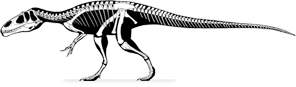
eustreptospondylus-skel.png
Pronunciation: yoo-STREP-to-SPON-di-luss
Meaning: True Streptospondylus
Author/s: Walker (1964)
Synonyms: Magnosaurus oxoniensis
First Discovery: Chipping Norton, England
Discovery Chart Position: #211

Eustreptospondylus oxoniensis

In the early-mid part of the 19th century, there was only a loose system of dinosaur classification, so most carnivorous dinosaurs were lumped with Megalosaurus — the very first dinosaur discovered in Oxford, England — and palaeontologists have been striving to clean up the mess ever since. Some carnivorous dinosaurs weren't so lucky and ended up in Streptospondylus: the critter that angels fear to prod. Eustreptospondylus has dabbled with both. May the gods guide our pen!

Update coming soon.
(True Streptospondylus from Oxford)Etymology
Eustreptospondylus is derived from the Greek "eu" (good, well, or in this case, true), "streptos" (turned, reversed) and "spondylos" (vertebra). Its remains were initially assigned to Streptospondylus cuveri, a second species of Streptospondylus which was long thought to be a crocodilian, but with vertebrae that were reversed compared to those of crocodiles, being opisthocoelous (convex in front and concave behind) rather than procoelous (vice versa). Eustreptospondylus can be literally read as "well-turned vertebra" but the intended meaning was "true Streptospondylus".
Discovery
The only remains of Eustreptospondylus were discovered by workers at the Summertown Brick Pit in the Stewartby Member of the Oxford Clay Formation, near Oxford, England, in 1870. The holotype (OUM J13558, housed at the Oxford University Museum of Natural History) is a partial skull and associated nearly complete skeleton.
Estimations
Timeline:
Era: Mesozoic
Epoch: Middle Jurassic
Stage: Callovian
Age range: 165-161 mya
Stats:
Est. max. length: 7 meters
Est. max. hip height: 2.1 meters
Est. max. weight: 500 Kg
Diet: Carnivore
Eustreptospondylus
oxoniensis
References
• Phillips J (1871) "Geology of Oxford and the Valley of the Thames". (page 319)
• Owen R (1842) "Report on British fossil reptiles". Report of the British Association for the Advancement of Science, 11: 60-204.
• Nopcsa F (1905) "Notes on British dinosaurs. Part III: Streptospondylus". Geological Magazine, 2: 289-293.
• Nopcsa F (1906) "Zur Kenntnis des Genus Streptospondylus". Beiträge zur Paläontologie und Geologie Österreich-Ungarns und des Orients: Mitteilungen des Geologischen und Paläontologischen Institutes der Universität Wien 19: 59-83.
• Walker AD (1964) "Triassic reptiles from the Elgin area: Ornithosuchus and the origin of carnosaurs". Philosophical Transactions of the Royal Society of London, Series B, Biological Sciences 248: 53-134.
• Weishampel DB et al (2004) Chapter 24: "Dinosaur Distribution" in Weishampel, Dodson and Osmólska (eds.) "The Dinosauria: Second Edition".
• Sadleir R, Barrett PM and Powell HP (2008) "The anatomy and systematics of Eustreptospondylus oxoniensis, a theropod dinosaur from the Middle Jurassic of Oxfordshire, England". Monograph of the Palaeontographical Society, London.
Email    Facebook    Twitter    Reddit    Pinterest
Time stands still for no man, and research is ongoing. If you spot an error, or want to expand, edit or add a dinosaur, please use this form. Go here to contribute to our FAQ.
All dinos are GM free, and no herbivores were eaten during site construction!
To cite this page:
Atkinson, L. "EUSTREPTOSPONDYLUS :: from DinoChecker's dinosaur archive".
›. Web access: 07th Mar 2026.
  top