








Pronunciation: not-o-SEH-ruh-tops
Meaning: Southern horned face
Author/s: Tapia (1918)
Synonyms: None known
First Discovery: Chubut, Argentina
Acta Ordinal: #124
Notoceratops bonarellii
When Augusto Tapia named the Argentine Notoceratops from Lago Colhué Huapí and assigned it to ceratopsia in 1918, he was nearly laughed out of science.
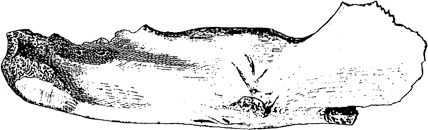
If you want your discovery to be considered a bona fide ceratopsian or horn-faced dinosaur, you need to have proof in the form of a fossilized horned face, or a horn that may have been attached to a face, or at least a face, but Notoceratops is known only from a dentary, the tooth-bearing bone of the lower jaw, and in this case it lacked the teeth.
Also hindering Tapia's case was the previous lack of ceratopsian remains from the entire Southern Hemisphere, never mind South America. And even when Serendipaceratops bolstered the number of potential ceratopsians from this side of the globe to a whopping two in 2003, the Notoceratops ceratopsian cause was not helped by the fact that its only known fossil was long lost by this point.
Notoceratops was eventually described in 1929 by Friedrich von Huene, who concurred with its ceratopsian affinities. However, since then, several authors have suggested it might instead be a member of Hadrosauria, the duck-billed dinosaurs from the ornithopod side of the Cerapoda track, but century-year old pencil drawings are notoriously uncooperative for classification purposes, and unfortunately that's all that remains of its... remains.
Incidentally, von Huene described a single "white as snow" tooth in the private collection of Florentino Ameghino, which was also found at Lago Colhué Huapí. He saw little difference between it and the only known tooth of Loncosaurus argentinus — long assumed to be a theropod and haphazardly assigned to Genyodectes in 1993 — which turned out to be an ornithopod. This might've added some weight to a hadrosaurian identity for Notoceratops, but alas, when Loncosaurus was reclassified it was relieved of its tooth, because it belongs to a different kind of dinosaur entirely. A partial ornithopod specimen from the same area was described in 2010, but it doesn't include a lower jaw.
Also hindering Tapia's case was the previous lack of ceratopsian remains from the entire Southern Hemisphere, never mind South America. And even when Serendipaceratops bolstered the number of potential ceratopsians from this side of the globe to a whopping two in 2003, the Notoceratops ceratopsian cause was not helped by the fact that its only known fossil was long lost by this point.
Notoceratops was eventually described in 1929 by Friedrich von Huene, who concurred with its ceratopsian affinities. However, since then, several authors have suggested it might instead be a member of Hadrosauria, the duck-billed dinosaurs from the ornithopod side of the Cerapoda track, but century-year old pencil drawings are notoriously uncooperative for classification purposes, and unfortunately that's all that remains of its... remains.
Incidentally, von Huene described a single "white as snow" tooth in the private collection of Florentino Ameghino, which was also found at Lago Colhué Huapí. He saw little difference between it and the only known tooth of Loncosaurus argentinus — long assumed to be a theropod and haphazardly assigned to Genyodectes in 1993 — which turned out to be an ornithopod. This might've added some weight to a hadrosaurian identity for Notoceratops, but alas, when Loncosaurus was reclassified it was relieved of its tooth, because it belongs to a different kind of dinosaur entirely. A partial ornithopod specimen from the same area was described in 2010, but it doesn't include a lower jaw.
(Bonarelli's Southern Horn Face)Etymology
Notoceratops is derived from the Greek "notos" (the South), "ceras" (horn) and "ops" (face) for its discovery in the Southern Hemisphere and presumed position as a ceratopsian (horn-faced) dinosaur.The species epithet, bonarellii (BON-uh-RELL-eye) honours Guido Bonarelli who advised Tapia in his study of the find. It is often mispelled with just the one "i".
Discovery
The only confirmed remains of Notoceratops were discovered in the Lago Colhué Huapí Formation (previously thought to be the Bajo Barreal Formation), in the vicinity of Lago (Lake) Colhué Huapí, Chubut province, Argentina, by Augusto Tapia in 1917.The holotype is a toothless lower jaw bone (dentiary). Its whereabouts in unknown.


