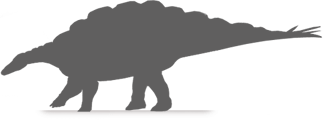
WUERHOSAURUS
a plant-eating stegosaurid thyreophoran dinosaur from the Early Cretaceous of China.
Pronunciation: woo-UHR-huh-SOR-us
Meaning: Wuerho lizard
Author/s: Dong (
1973)
Synonyms: See
below
First Discovery: Xinjiang, China
Acta Ordinal: #242
Wuerhosaurus homheni
(Wuerho lizard with flat and wide hips)Etymology
Wuerhosaurus is derived from "Wuerho" (a town close to its place of discovery) and the Greek "sauros" (lizard).
The
species epithet,
homheni, means "flat and wide" in Latin, in reference to the design of its hips.
ZooBank registry:
urn:lsid:zoobank.org:act:A084528A-86A7-49F4-8CB4-29DDF88089AB.
Stegosaurus homheni (Maidment
et al. 2008)
Discovery
The first fossils of
Wuerhosaurus were recovered from the Lianmugin Formation (Tugulu Group) near the town of Wuerho, Xinjiang, China.
The
holotype (IVPP V.4006) is a skull-less fragmentary skeleton. Some tail bones (IVPP V4007) from a second individual were also discovered in the same bonebed.
Estimations
Timeline:
Era: Mesozoic
Epoch: Early Cretaceous
Stage: Berriasian-Valanginian
Age range: 145-136 mya
Stats:
Est. max. length: 7 meters
Est. max. hip height: 2 meters
Est. max. weight: 3.5 tons
Diet: Herbivore

Other species
Wuerhosaurus ordosensis (IVPP V6877—a fragmentary skeleton lacking the skull, and referred specimens IVPP V6878 and 6879 from the same locality) was discovered in the Ejinhoro Formation, Ordos Basin of Inner Mongolia, in 1988. A couple of meters shorter than
Wuerhosaurus homheni, perhaps two tons lighter and with a shorter neck,
Wuerhosaurus ordosensis was named in 1993 by Zhiming Dong. Maidment
et al. renamed it
Stegosaurus homheni in 2008, but most paleontologists still cast suspicious glances at it.
Wuerhosaurus mongoliensis (PIN Coll.—back and tail vertebrae and a lump of pelvic girdle
from the Khukhtyk Formation) was coined by freelancer Roman Ulansky in 2014. Apparently, its hip is more massive and the spines on its vertebra are thicker and higher than other species of
Wuerhosaurus, and it sports a relatively large
spinal canal. But because of Ulansky's habit of naming dinosaurs willy-nilly based on material that other paleontologists have already dismissed as tat, plus the fact that his papers are only ever released in Russian, this critter may never be taken seriously by experts. Or so we thought. It was officially renamed
Mongolostegus exspectabilis by Tumanova and Alifanov in 2018.
References
Time stands still for no man, and research is ongoing. If you spot an error, or want to expand, edit or add a dinosaur, please use
this form. Go
here to contribute to our FAQ.
All dinos are GM free, and no herbivores were eaten during site construction!
To cite this page:
Atkinson, L.
"
WUERHOSAURUS :: from DinoChecker's dinosaur archive".
‹
http://www.dinochecker.com/dinosaurs/WUERHOSAURUS›. Web access: 09th Sep 2026.