PHUWIANGOSAURUS
a plant-eating titanosaurian sauropod dinosaur from the Late Cretaceous of Thailand.

Pronunciation: POO-WYAHNG-o-SOR-us
Meaning: Phu Wiang lizard
Author/s: Martin
et al. (
1994)
Synonyms: None known
First Discovery: Phu Wiang, Thailand
Acta Ordinal: #398
Phuwiangosaurus sirindhornae
(Sirindhorn's Phu Wiang lizard)
Etymology
Phuwiangosaurus is derived from "Phu Wiang" (the district in which it was discovered) and the Greek "sauros" (lizard).
The
species epithet,
sirindhornae, honors Princess Maha Chakri Sirindhorn of Thailand "for her great interest in paleontological studies".
Discovery
The first remains of
Phuwiangosaurus were discovered in the Sao Khua Formation, at Phu Wiang 1 site ("Phu Pratu Teema") in the hills of Phu Wiang district, Khon Kaen Province, northeastern Thailand, by a Thai-French expedition in 1982. The
holotype (SM PW1-1 to SM PW1-22) is a 10% complete and partly articulated skeleton including three cervical (neck) vertebrae, three dorsal (back) vertebrae, scapulae (shoulder blades), left humerus (upper arm bone), partial left ulna (forearm bone), ilia,
pubes and ischia (hip bones), femora (thighs), left fibula (shin), and a chevron. Some theropod teeth were found mingled with the remains.
Estimations
Timeline:
Era: Mesozoic
Epoch: Early Cretaceous
Stage: Valanginian-Hauterivian
Age range: 140-130 mya
Stats:
Est. max. length: 20 meters
Est. max. hip height: 5 meters
Est. max. weight: 24 tons
Diet: Herbivore
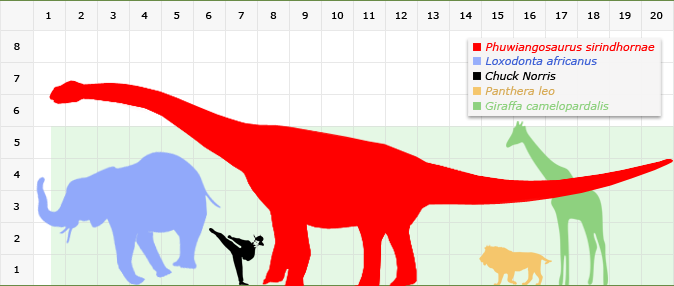
Phuwiangosaurus
sirindhornae
References
• Martin V, Suteethorn V and Buffetaut E (1994) "A new genus of sauropod dinosaur from the Sao Khua formation (Late Jurassic or early Cretaceous) of northeastern Thailand".
Comptes Rendus de l'Académie des Sciences de Paris, 319: 1085-1092.
• Martin V (1994) "
Baby sauropods from the Sao Khua Formation Lower Cretaceous in northeastern Thailand".
Gaia, N°10: 147-153
• Buffetaut E and Suteethorn V (1998) "Early Cretaceous dinosaurs from Thailand and their bearing on the early evolution and biogeographical history of some groups of Cretaceous dinosaurs".
New Mexico Museum of Natural History and Science Bulletin, 14: 205-210
• Martin V, Suteethorn V and Buffetaut E (1999) "Description of the type and referred material of
Phuwiangosaurus sirindhornae Martin, Buffetaut and Suteethorn, 1994, a sauropod from the Lower Cretaceous of Thailand".
Oryctos, 2: 39-91.
• Suteethorn S, Le Loeuff J, Buffetaut E, Suteethorn V, Talubmook C and Chonglakmani C (2009) "A new skeleton of
Phuwiangosaurus sirindhornae (Dinosauria, Sauropoda) from NE Thailand".
Geological Society, London, Special Publications, 315(1): 189-215. DOI: 10.1144/SP315.14.
• Klein N, Sander M and Suteethorn V (2009) "Bone histology and its implications for the life history and growth of the Early Cretaceous titanosaur
Phuwiangosaurus sirindhornae".
Geological Society, London, Special Publications 315(1): 217-228. DOI: 10.1144/SP315.15.
• Suteethorn S, Le Loeuff J, Buffetaut E and Suteethorn V (2010) "
Description of topotypes of Phuwiangosaurus sirindhornae, a sauropod from the Sao Khua Formation (Early Cretaceous) of Thailand, and their phylogenetic implications".
Neues Jahrbuch für Geologie und Paläontologie - Abhandlungen 256(1): 109-121. DOI: 10.1127/0077-7749/2010/0036.
• Kaikaew S, Suteethorn V, Deesri U and Suteethorn S (2022) "The endocast of
Phuwiangosaurus sirindhornae from the Lower Cretaceous of Thailand".
Cretaceous Research, 144(2): 105434. DOI: 10.1016/j.cretres.2022.105434.
Time stands still for no man, and research is ongoing. If you spot an error, or want to expand, edit or add a dinosaur, please use
this form. Go
here to contribute to our FAQ.
All dinos are GM free, and no herbivores were eaten during site construction!
To cite this page:
Atkinson, L.
"
PHUWIANGOSAURUS :: from DinoChecker's dinosaur archive".
‹
http://www.dinochecker.com/dinosaurs/PHUWIANGOSAURUS›. Web access: 09th Sep 2026.