


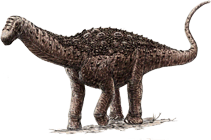
Pronunciation: MAK-row-NEH-ree-uh
Author: Wilson and Sereno
Year: 1998
Meaning: Big Nostrils (see etymology)
Locomotion: Quadrupedal (four legs)
Synonyms: Camarasauromorpha?
[Sereno, 2005]Definition
The most inclusive clade containing Saltasaurus loricatus but not Diplodocus longus.
About
Macronaria appears in the Middle Jurassic as the sister group to Diplodocoidea. Defined as the most inclusive clade containing Saltasaurus loricatus but not Diplodocus longus, it marks one of the major branching points in sauropod evolution, where two lineages follow vastly different architectural trajectories.
The name Macronaria—"large nostrils"—refers to one of the clade's hallmark characteristics: enlarged nostril openings that were bigger than their eye sockets. Macronarians share a broader cranial suite as well: deep, wide skulls, expanded snouts, and robust, spoon-shaped teeth suited to tougher vegetation. Their cervical vertebrae are shorter and stronger than those of diplodocoids, supporting a neck capable of elevated and mid-level feeding rather than extreme horizontal sweep. The torso is deep and voluminous, and the limbs are stout and columnar, with brachiosaurids developing especially long forelimbs and titanosaurs shifting toward more level-bodied postures. These traits give macronarians a wide ecological range, from high-browsing specialists to mixed-height foragers in open or semi-open habitats.
Macronaria becomes the dominant sauropod lineage from the Late Jurassic into the Cretaceous. Its branches include the generalist Camarasaurus, the tall-limbed brachiosaurids, and the titanosaurs, which diversify into everything from island dwarfs to the largest land animals known. Armour, extreme size, and global distribution all evolve within the clade.
Click here to view Dinochecker's A-Z list of Macronarians.
Etymology
Macronaria is derived from the Greek "makros" (big) and the Latin "nares" (nostrils).
Relationships
References
• D'Emic MD (2012) "The early evolution of titanosauriform sauropod dinosaurs". Zoological Journal of the Linnean Society. 166 (3): 624-671.
• Carrano MT (2005) "The sauropods: evolution and paleobiology".
• Upchurch P, Barrett PM and Dodson P (2004) "Sauropoda". Page 259-322 in Weishampel, Dodson and Osmolska (eds.) "The Dinosauria: Second Edition".


