







Pronunciation: lah-boh-KAHN-ee-uh
Meaning: for La Bocana Roja
Author/s: Molnar (1974)
Synonyms: None known
First Discovery: El Rosario, Mexico
Acta Ordinal: #246
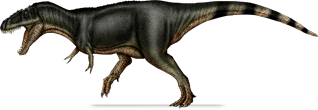
Labocania anomala
Discovered during a 1970 joint National Geographic Society and Los Angeles County Museum of Natural History expedition in a rock formation known as la Bocana Roja (which is often mistranslated as "red lips"), Labocania was described by Ralph Molnar as "a distinctive theropod" because of its unique features. Unfortunately, red lips wasn't one of them, but hey, absence of evidence is not evidence of absence.
Its remains were meagre, badly weathered, disjointed and spread over an area a couple of meters square, and to top it off they were mingled with the ribs of a hadrosauroid, but the bits that were salvaged sported a truly bizarre suite of features. Its skull elements are very thick and robust, similar in style to abelisaurids, its teeth are recurved and rather flat, similar to but much larger than those of Deinonychus, one of its hip bones (ischium) bears an uncanny resemblance to the corresponding bone in tyrannosauroids, and Molnar noted similarities to "Chilantaisaurus" maortuensis which is now a carcharodontosaurid known as Shaochilong.
Features of a foot bone (metatarsal) and form of a tail bone (chevron) make Labocania a shoo-in tetanuran but, despite being the first theropod named from Mexico, Tetanurae incertae cedis (of uncertain placement) was about as precise as any palaeontologist was willing to be. Until 2024.
Its remains were meagre, badly weathered, disjointed and spread over an area a couple of meters square, and to top it off they were mingled with the ribs of a hadrosauroid, but the bits that were salvaged sported a truly bizarre suite of features. Its skull elements are very thick and robust, similar in style to abelisaurids, its teeth are recurved and rather flat, similar to but much larger than those of Deinonychus, one of its hip bones (ischium) bears an uncanny resemblance to the corresponding bone in tyrannosauroids, and Molnar noted similarities to "Chilantaisaurus" maortuensis which is now a carcharodontosaurid known as Shaochilong.
Features of a foot bone (metatarsal) and form of a tail bone (chevron) make Labocania a shoo-in tetanuran but, despite being the first theropod named from Mexico, Tetanurae incertae cedis (of uncertain placement) was about as precise as any palaeontologist was willing to be. Until 2024.
Etymology
Labocania is named for "La Bocana Roja" - the formation in which it was discovered.The species epithet, anomala, is derived from the Latin "anomalous" (deviating from what is standard, normal, or expected), referring to its distinctive build.
Discovery
The remains of Labocania were discovered in the La Bocana Roja Formation at El Rosario, Baja California, Mexico by Harley James Garbani, during a joint National Geographic Society and Los Angeles County Museum of Natural History paleontological expedition, led by geologist William J. Morris, in 1970.The holotype (LACM 20877) is a partial skeleton.
Other species
Labocania aguillonae (Rivera-Sylva and Longrich, 2024)


