




Pronunciation: ka-ROH-no-SOR-us
Meaning: Charon's lizard
Author/s: Godefroit, Zan and Jin (2000)
Synonyms: None known
First Discovery: Heilongjang, China
Acta Ordinal: #484
Charonosaurus jiayinensis
Charonosaurus is a Chinese lambeosaurine hadrosaurid named after Charon, the surly Greek ferryman of the River Styx who would taxi souls to Hades, provided they could pay the fare of one Obolus, which was strategically placed under their tongue. Its discovery on the banks of another dark river — the Chinese side of the Amur known as Heilongjiang (Black Dragon River) — is the origin of its name. And an upper leg bone seems to be the source of its often-stated and rather impressive stats.
Extrapolated from a 135cm thighbone, Charonosaurus was huge. Upper estimates suggest a length of almost 13 meters and a mass of 7 tons; longer and almost as heavy as the largest specimens of T. rex, around half the size again of Tsintaosaurus, and perhaps only beaten in hadrosaurid circles by China's colossal Shantungosaurus. However, some experts suspect those measurements are a tad on the generous side, and a more modest 10 meters and 4-5 tons seems more likely. Its headgear has also been the subject of much speculation.
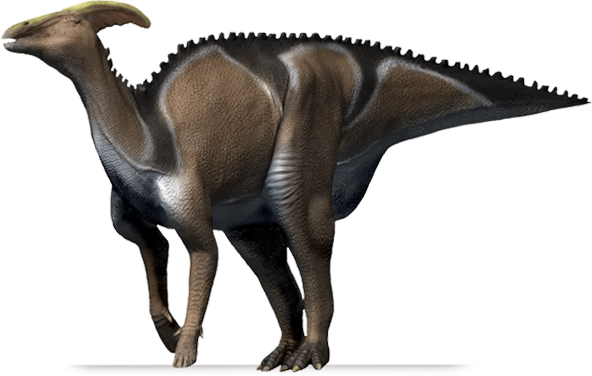
Although there isn't a lot of physical evidence to back up the presence of a crest, many features of its partially known skull suggest Charonosaurus may have had an appendage much like the North American Parasaurolophus, whose snout formed a long, hollow tube that extended backwards well above and beyond the end of its skull. Many lambeosaurines had crests of one form or another, with inter-species identification one of the top suggested uses. Nothing says "hey" like the bellow of an enormous nose trumpet when rallying the herd or trying to find a mate, but a predator-disabling sonic boom, as suggested by one particular TV documentary, was probably a tall order.
Extrapolated from a 135cm thighbone, Charonosaurus was huge. Upper estimates suggest a length of almost 13 meters and a mass of 7 tons; longer and almost as heavy as the largest specimens of T. rex, around half the size again of Tsintaosaurus, and perhaps only beaten in hadrosaurid circles by China's colossal Shantungosaurus. However, some experts suspect those measurements are a tad on the generous side, and a more modest 10 meters and 4-5 tons seems more likely. Its headgear has also been the subject of much speculation.
Although there isn't a lot of physical evidence to back up the presence of a crest, many features of its partially known skull suggest Charonosaurus may have had an appendage much like the North American Parasaurolophus, whose snout formed a long, hollow tube that extended backwards well above and beyond the end of its skull. Many lambeosaurines had crests of one form or another, with inter-species identification one of the top suggested uses. Nothing says "hey" like the bellow of an enormous nose trumpet when rallying the herd or trying to find a mate, but a predator-disabling sonic boom, as suggested by one particular TV documentary, was probably a tall order.
Etymology
Charonosaurus is derived from "Charon" (ferryman of the Styx in Greek mythology) and the Greek "sauros" (lizard).
The species epithet, jiayinensis, means "from Jiayin" (see discovery) in Latin.
Discovery
The remains of Charonosaurus were discovered in the Yuliangze Formation near Jiayin Village, Heilongjang Province, China, in 1975.
The holotype (CUST JV1251-57, housed at Changchun University of Sciences and Technology, Changchun, Jilin Province, China) is a partial skull that was mingled with remains of various growth stages of hadrosaur and ankylosaur. The lay of the bones indicates they were carried to their resting place by a swirling river that was home to the fossilized crocodiles and turtles haphazardly scattered throughout the site. Theropod teeth were found there too, but it's unclear whether they slayed the herbivores or arrived at the site when the waters had subsided to scavenge their carcasses.
In 1916 and 1917, the Russian Geological Committee had already undertaken two excavation campaigns to this area, which resulted in the naming of two hadrosaurs: Trachodon amurense (Riabinin, 1925) that was renamed Mandschurosaurus amurensis (Riabinin, 1930), and Saurolophus krystofovici (Riabinin, 1930). However, the former is several specimens fudged together with so much plaster that it's impossible to tell how much of it is real bone, while the latter is based on a very fragmentary ischium (hip bone) that may not belong to a hadrosaur. Unsurprisingly, both critters are considered highly dubious, due to their fragmentary and non-diagnostic fossils.


