




Pronunciation: SOO-ko-MY-mus
Meaning: Crocodile mimic
Author/s: Sereno et al. (1998)
Synonyms: Baryonyx tenerensis (Sues et al., 2002)
First Discovery: Gadoufaoua, Niger
Acta Ordinal: #449
Suchomimus tenerensis
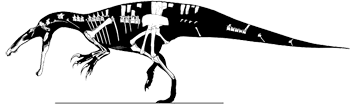
Discovered in the heart of Niger's Sahara desert, the spinosaurid theropod Suchomimus, with its distinctly crocodile-like snout, powerful forelimbs, long thumb claws, and cone-shaped teeth, was a fish hunter like no other. Except, it was like another.
Because of remarkably similar features, right down to the spines on some of its vertebrae that may have supported a modest sail, many consider Suchomimus to be an African species of the European Baryonyx. Both are thought to have been fish eaters, loitering in shallow water or sitting on riverbanks to "hook" unsuspecting prey with their thumb claws. But some researchers have gone further, speculating that spinosaurids’ powerfully built tails, dorsal sails, nostril position, and the angle at which they held their heads, point to no less than a semi-aquatic lifestyle.
Brian J. Ford was still peddling his aquatic lifestyle hypothesis as recently as 2012, insisting it applies to ALL dinosaurs—based less on evidence than on his belief that "dinosaurs just look wrong ambling about on land". Unsurprisingly, his theory has been consistently and mercilessly dismissed by specialists, some of whom derided Ford as "a glorified amateur who likes to play with his toy dinosaurs". Ouch. Yet in 2015, a review of Spinosaurus reignited debate, at least across the spinosaurid family: its bone density, limb proportions, and snout pits—interpreted as integumentary sensory organs (ISOs) similar to those in modern crocodiles—suggest it may have been fully aquatic, though this interpretation has also met resistance from many palaeontologists.
Suchomimus tenerensis smashed the record for the number of co-authors involved in a new dinosaur paper when Paul Sereno, Allison Beck, Didier Dutheil, Boubacar Gado, Hans Larsson, Gabrielle Lyon, Jonathan Marcot, Oliver Rauhut, Rudyard Sadleir, Christian Sidor, David Varricchio, Gregory Wilson, and Jeffrey Wilson all stuck their non-clawed thumbs in the proverbial pie in 1998. Unfortunately, Suchomimus will probably end up being sunk as a synonym of Baryonyx, which was named first and therefore has priority. Cristatusaurus from Niger may share the same fate.
Because of remarkably similar features, right down to the spines on some of its vertebrae that may have supported a modest sail, many consider Suchomimus to be an African species of the European Baryonyx. Both are thought to have been fish eaters, loitering in shallow water or sitting on riverbanks to "hook" unsuspecting prey with their thumb claws. But some researchers have gone further, speculating that spinosaurids’ powerfully built tails, dorsal sails, nostril position, and the angle at which they held their heads, point to no less than a semi-aquatic lifestyle.
Brian J. Ford was still peddling his aquatic lifestyle hypothesis as recently as 2012, insisting it applies to ALL dinosaurs—based less on evidence than on his belief that "dinosaurs just look wrong ambling about on land". Unsurprisingly, his theory has been consistently and mercilessly dismissed by specialists, some of whom derided Ford as "a glorified amateur who likes to play with his toy dinosaurs". Ouch. Yet in 2015, a review of Spinosaurus reignited debate, at least across the spinosaurid family: its bone density, limb proportions, and snout pits—interpreted as integumentary sensory organs (ISOs) similar to those in modern crocodiles—suggest it may have been fully aquatic, though this interpretation has also met resistance from many palaeontologists.
Suchomimus tenerensis smashed the record for the number of co-authors involved in a new dinosaur paper when Paul Sereno, Allison Beck, Didier Dutheil, Boubacar Gado, Hans Larsson, Gabrielle Lyon, Jonathan Marcot, Oliver Rauhut, Rudyard Sadleir, Christian Sidor, David Varricchio, Gregory Wilson, and Jeffrey Wilson all stuck their non-clawed thumbs in the proverbial pie in 1998. Unfortunately, Suchomimus will probably end up being sunk as a synonym of Baryonyx, which was named first and therefore has priority. Cristatusaurus from Niger may share the same fate.
(Crocodile Mimic from Ténéré)Etymology
Suchomimus is derived from the Greek "Souchos" (crocodile) and "mimos" (mimic), so named because of its low, elongated snout and fish-snagging features.
The species epithet, tenerensis, means "from Ténéré" in Latin.
Discovery
The first remains of Suchomimus were discovered in the Tegama Beds of the Elrhaz Formation at Gadoufaoua (known to locals as "the place where camels fear to go"), amid dune fields in the Ténéré region of Niger's Sahara Desert, by David Varricchio in 1997.
The holotype (MNN GDF500, currently housed at the Musee National du Niger, Niamey, Republic of Niger) is the partial skull and disarticulated skeleton of a sub-adult. Referred fossils include connected front upper jaw bones (MNN GDF501), a right jaw joint bone known as the quadrate (MNN GDF502), pieces of the lower jaws (MNN GDF503, GDF504, and GDF505), the axis vertebra from the neck (MNN GDF506), another neck vertebra (MNN GDF507), a back vertebra (MNN GDF508), two tail vertebrae (MNN GDF510 and GDF511), along with many other bones and teeth.


