




Pronunciation: SEF-uh-PAR-no-SOR-us
Meaning: Cross lizard
Author/s: Otero et al. (2015)
Synonyms: None known
First Discovery: Free State, South Africa
Acta Ordinal: #911
Sefapanosaurus zastronensis
(Cross lizard from Zastro)Etymology
Sefapanosaurus is derived from the Sesotho word "sefapano" (cross) and the Greek "sauros" (lizard), in reference to the Tau Cross-shaped (or "T"-shaped) projection of bone (aka ascending process) on the ankle.
The species epithet, zastronensis, means "from Zastron" in Latin.
ZooBank registry: urn:lsid:zoobank.org:act:382B829A-EA84-475C-8FB5-9A333A960EE5.
Discovery
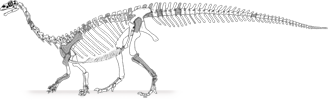
The remains of Sefapanosaurus were discovered in the Upper Elliot Formation close to the town of Zastron, about 30 km west of the Lesotho border, in the Free State Province of South Africa, by A. W. Keyser, between 1936 and 1946.The holotype (BP/1/386) is an ankle, a heel bone, and three metatarsals from the left foot. Referred material (BP/1/7409—7450), collected from the same locality as the holotype, includes the remains of at least four individuals, including BP/1/7409, 7410, 7411, 7412, 7413 (parts of five neck vertebrae), BP/1/7414, 7415—7417, 7418, 7419, 7420, 7421, 7423, 7431 (nine back bones), BP/1/7422 and 7424—7429 (seven tail vertebrae) and BP/1/7430 (one chevron), BP/1/7432 (a left shoulder bone), BP/1/7433 (a right shoulder blade), BP/1/7434 (the top half of a right upper arm), BP/1/7435—7437 (three lower arm bones), BP/1/7438 (a partial left hand), BP/1/7439 and 7450 (two pieces of pelvic bone), BP/1/7440—7443 (the top ends of four thigh bones of different sizes, indicating that this assemblage contains a minimum of four individuals) plus BP/1/7444 (one bottom end), BP/1/7445 (the top end of a right shin), BP/1/7446 (the bottom end of a right calf), BP/1/7447 (a left calf), and BP/1/7448 and 7449 (one complete and one partial foot bone). All of these fossils were catalogued as Euskelosaurus by James W. Kitching, and subsequently referred to Aardonyx by Adam Yates.


