






Pronunciation: PU-lan-SOR-ruh
Meaning: Rain bringer lizardess
Author/s: McPhee et al. (2015)
Synonyms: None known
First Discovery: Free State, South Africa
Acta Ordinal: #916
Pulanesaura eocollum
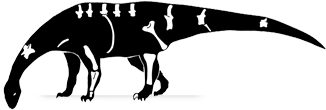
Pulanesaura was discovered in the same quarry as Arcusaurus pereirabalorum and only a stonesthrow from the site of Aardonyx celestae, and the three highlight Mother Nature's niche partitioning in full flow. To minimise competition for fodder, Arcuaurus was small and fully bipedal (2 legged), while Ardonyx could walk quadrupedally (on four legs) but still rear up to feed, and both relied upon their arms to gather or manipulate food. Pulanesaura spent all of its time on all fours and sports features that hint at the onset of what later sauropods became masters at: they conserved energy by standing in one place and sweeping their long neck across swathes of vegetation.
(Early-necked, rain-bringer lizardess)Etymology
Pulanesaura is derived from the Sesotho "Pulane" (rain-bringer/maker, in reference to the rain-soaked conditions under which the dinosaur was excavated) and the Greek "saura" (feminine form of "sauros", meaning lizard).
The species epithet, eocollum,
is derived from the Greek "eo" (dawn) and the Latin "collum" (neck), in reference to the hypothesized function of its neck that would be adopted and mastered by later sauropods, and lead to the demise of the "prosauropods".
Discovery
The remains of Pulanesaura were discovered in the upper Elliot Formation at "Sauropod Quarry" on the farm Spion Kop 932, just over a kilometer East-North East of "Marc's Quarry" that yielded the holotype of Aardonyx celestae, Senekal District, Free State, South Africa, in 2004.
The holotype (BP/1/6882) is the arch of a back vertebra. Fellow sauropodomorph Arcusaurus pereirabdalorum was found on the edge of the same quarry.


