




Pronunciation: GOR-go-SOR-us
Meaning: Dreadful lizard
Author/s: Lawrence Lambe (1914)
Synonyms: See below
First Discovery: Alberta, Canada
Acta Ordinal: #114
Gorgosaurus libratus
In the summer of 1913, fossil hunter Charles H. Sternberg was scouring the sandstone cliffs of Alberta’s Dinosaur Provincial Park when he unearthed the nearly complete skeleton of a massive theropod dinosaur—the first tyrannosaurid ever discovered with a complete hand. At the same time, prospectors from the American Museum of Natural History in New York City were scouring the same region, collecting hundreds of spectacular specimens, including four complete, nearly identical theropod skulls, three of which were associated with skeletons. However, their team—led by William Diller Matthew and Barnum Brown—dragged their heels for a decade before publishing their findings. This gave Canadian paleontologist Lawrence Lambe the opportunity to claim naming rights by formally describing Sternberg’s specimen as the holotype—the single physical example used to define and name a new species—in 1914, christening it Gorgosaurus libratus, or "the balanced dreadful lizard."
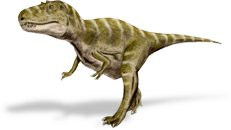
At roughly 8–9 meters long and weighing around 2.5 tonnes, Gorgosaurus was both a textbook tyrannosaurid and a subtle outlier. The skull was massive, packed with bone-crunching teeth and capable of a devastating bite, but proportionally longer and lower than in most of its kin. Its legs had the stretch on most other tyrannosaurids too, with longer shins than thighs, typical of swift-running theropods. The feet bore three weight-bearing toes, plus a reduced inner digit—a vestigial "toe thumb" that hovered above the ground, while the arms followed the familiar tyrannosaurid blueprint: tiny but muscular, ending in two clawed fingers. Its closest relative, Albertosaurus sarcophagus, is so remarkably similar in size and anatomy that some paleontologists have proposed merging the two, with Gorgosaurus relegated to a junior synonym under the hugely inconsistent "first name stands" rule. Yet there are as many anatomical differences between Gorgosaurus and Albertosaurus as there are between Daspletosaurus and Tyrannosaurus—a pair almost universally treated as distinct. Given its earlier appearance in the fossil record, Gorgosaurus may well be ancestral to Albertosaurus, representing an evolutionary stage in the albertosaurine lineage rather than a mere variation. The debate remains lively, but for now, Gorgosaurus keeps its name.
From a classification standpoint, Gorgosaurus has been both a magnet and a misfire. Several fragmentary theropods once thought to be distinct genera—like Deinodon horridus and Laelaps incrassatus—have since been synonymized with it. Meanwhile, some specimens initially assigned to Gorgosaurus turned out to be impostors. Gorgosaurus lancensis, for example, was later renamed Nanotyrannus, a supposed dwarf tyrannosaur now widely considered a juvenile Tyrannosaurus. From Mongolia, Gorgosaurus novojilovi was renamed Maleevosaurus before being absorbed into Tarbosaurus bataar, a closely related species often regarded as the Asian counterpart to North America's all-time apex predator. These shifting identities underscore the perils of naming species from immature or fragmentary material—and reflect the ever-evolving, often contentious landscape of tyrannosaurid taxonomy.
Despite the naming drama, Gorgosaurus has gifted paleontology with a treasure trove of pathology. Many specimens show signs of a rough-and-tumble life: healed fractures, infected bone tissue, and bite marks—some possibly from other tyrannosaurids. Several specimens show healed lower leg fractures, with the fibulae being particularly prone, while others display facial injuries that may have resulted from intraspecific squabbles or unlucky hunting attempts. Most astonishingly, one Gorgosaurus skull revealed evidence of a brain tumor—likely a meningioma—making it the first known case of such a condition in a dinosaur. The afflicted animal also bore numerous skeletal injuries, suggesting it may have suffered from balance or coordination issues late in life. These fossils paint a vivid picture of a predator that lived hard, healed often, and left behind a fossil record as medically intriguing as it is anatomically impressive.
With dozens of reasonably complete specimens, Gorgosaurus is the best-represented tyrannosaurid in the fossil record, offering insights into growth stages, behavior, and even brain anatomy. CT scans of its skull suggest a keen sense of smell and decent vision—handy tools for a predator navigating a landscape teeming with duck-billed distractions. Some specimens preserve scaley skin impressions, offering rare glimpses into its outer appearance, while others contain gut contents, shedding light on its diet and digestive habits. Whether it stands alone or is ultimately subsumed into Albertosaurus, Gorgosaurus is currently one of the most vivid and revealing tyrannosaurids yet discovered—swift in stride, savage in bite, and dreadful enough to earn its name.
At roughly 8–9 meters long and weighing around 2.5 tonnes, Gorgosaurus was both a textbook tyrannosaurid and a subtle outlier. The skull was massive, packed with bone-crunching teeth and capable of a devastating bite, but proportionally longer and lower than in most of its kin. Its legs had the stretch on most other tyrannosaurids too, with longer shins than thighs, typical of swift-running theropods. The feet bore three weight-bearing toes, plus a reduced inner digit—a vestigial "toe thumb" that hovered above the ground, while the arms followed the familiar tyrannosaurid blueprint: tiny but muscular, ending in two clawed fingers. Its closest relative, Albertosaurus sarcophagus, is so remarkably similar in size and anatomy that some paleontologists have proposed merging the two, with Gorgosaurus relegated to a junior synonym under the hugely inconsistent "first name stands" rule. Yet there are as many anatomical differences between Gorgosaurus and Albertosaurus as there are between Daspletosaurus and Tyrannosaurus—a pair almost universally treated as distinct. Given its earlier appearance in the fossil record, Gorgosaurus may well be ancestral to Albertosaurus, representing an evolutionary stage in the albertosaurine lineage rather than a mere variation. The debate remains lively, but for now, Gorgosaurus keeps its name.
From a classification standpoint, Gorgosaurus has been both a magnet and a misfire. Several fragmentary theropods once thought to be distinct genera—like Deinodon horridus and Laelaps incrassatus—have since been synonymized with it. Meanwhile, some specimens initially assigned to Gorgosaurus turned out to be impostors. Gorgosaurus lancensis, for example, was later renamed Nanotyrannus, a supposed dwarf tyrannosaur now widely considered a juvenile Tyrannosaurus. From Mongolia, Gorgosaurus novojilovi was renamed Maleevosaurus before being absorbed into Tarbosaurus bataar, a closely related species often regarded as the Asian counterpart to North America's all-time apex predator. These shifting identities underscore the perils of naming species from immature or fragmentary material—and reflect the ever-evolving, often contentious landscape of tyrannosaurid taxonomy.
Despite the naming drama, Gorgosaurus has gifted paleontology with a treasure trove of pathology. Many specimens show signs of a rough-and-tumble life: healed fractures, infected bone tissue, and bite marks—some possibly from other tyrannosaurids. Several specimens show healed lower leg fractures, with the fibulae being particularly prone, while others display facial injuries that may have resulted from intraspecific squabbles or unlucky hunting attempts. Most astonishingly, one Gorgosaurus skull revealed evidence of a brain tumor—likely a meningioma—making it the first known case of such a condition in a dinosaur. The afflicted animal also bore numerous skeletal injuries, suggesting it may have suffered from balance or coordination issues late in life. These fossils paint a vivid picture of a predator that lived hard, healed often, and left behind a fossil record as medically intriguing as it is anatomically impressive.
With dozens of reasonably complete specimens, Gorgosaurus is the best-represented tyrannosaurid in the fossil record, offering insights into growth stages, behavior, and even brain anatomy. CT scans of its skull suggest a keen sense of smell and decent vision—handy tools for a predator navigating a landscape teeming with duck-billed distractions. Some specimens preserve scaley skin impressions, offering rare glimpses into its outer appearance, while others contain gut contents, shedding light on its diet and digestive habits. Whether it stands alone or is ultimately subsumed into Albertosaurus, Gorgosaurus is currently one of the most vivid and revealing tyrannosaurids yet discovered—swift in stride, savage in bite, and dreadful enough to earn its name.
(Balanced fierce lizard)Etymology
Gorgosaurus is derived from the Greek "gorgos" (dreadful, fierce, terrible) and sauros" (lizard). Contrary to some sources, Gorgosaurus wasn't named after the "Gorgons" from Greek mythology, though they were pretty fierce themselves. The species epithet, libratus, means "balanced" in Latin. Deinodon horridus? (Cope, 1876)
Laelaps falculus? (Cope, (1876)
Laelaps hazenianus? (Cope, (1876)
Laelaps incrassatus (Cope, (1876)
Dryptosaurus kenabekides? (Hay, 1899)
Gorgosaurus sternbergi (Matthew & Brown, 1923)
Discovery
The first remains of Gorgosaurus were discovered in the Dinosaur Park Formation, "3½ miles below the mouth of Berry Creek" at Steveville, southside of the Red Deer River, Alberta, Canada, by Charles Mortram Sternberg during an expedition from the Geological Survey of Canada (led by his father Charles Hazelius Sternberg) in 1913.The holotype (NMC 2120) is a nearly complete skeleton (the first tyrannosaurid specimen found with a complete hand) and an associated skull.
Among dozens of known specimens, one found by Cliff and Sandy Linster in 1997 near the town of Choteau in western Montana, contains a possible two-inch-wide brain tumor, which would be the first ever identified in a fossilised animal.
Habitat
The homeland of Gorgosaurus was a sub-tropical coastal plain along the western edge of an inland sea (the Western Interior Seaway, which cut North America in two on the vertical), with forests of huge conifers and tree ferns, many smaller ferns, and angiosperms.
The up-rising Rockies unleashed great rivers resulting in vast floodplains, but periodic drought was still a problem. The area's fossil record shows massive mortality amongst herding dinosaurs, perhaps due to a lack of water, then cruelly too much of it, as the Bearpaw Sea expanded to drown the Dinosaur Park Fauna around 73 million years ago.


