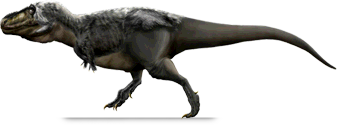
a meat-eating tyrant lizard dinosaur from the Latest Cretaceous of North America.
Pronunciation: ti-RAN-o-SOR-us
Meaning: Tyrant Lizard
Author/s: H.F.
Osborn (
1905)
Synonyms: See
below
First Discovery: Wyoming, USA
Acta Ordinal: #94
Tyrannosaurus rex
Tyrant lizard King
Etymology
Tyrannosaurus is derived from the Greek "tyrannos" (tyrant) and "sauros" (lizard).
The
species epithet,
rex, means "king" in Latin.
Zoobank registry:
urn:lsid:zoobank.org:act:D7D6DF08-5B63-4810-926D-AA0920D76FE5.
Manospondylus gigas (Cope, 1892)
Dynamosaurus imperiosus (Osborn, 1905)
Stygivenator molnari (Paul, 1988)
Dinotyrannus megagracilis (Olshevsky, 1995)
Discovery
The first confirmed remains of
Tyrannosaurus rex, BMNH R7994 (originally AMNH 5866 and known as
Dynamosaurus imperiosus), were discovered at Seven Mile Creek in Wyoming's Lance Formation by Barnum Brown in 1900 and have resided in the collections of London's Museum of Natural History since 1960. But fossils found even earlier than that — two partial vertebrae (AMNH 3982) from the Cretaceous units of western South Dakota that Cope named
Manospondylus gigas in 1892, and a metatarsal IV (USNM 2110), a left thigh, shin and
partial calf (USNM 8064), and a hip bone (USNM 6183) from the "Laramie Beds" (now Lance Formation) of eastern Wyoming that Marsh named
Ornithomimus grandis in 1896 — were both later identified as belonging to
Tyrannosaurus.
However, the actual
holotype is a partial skeleton, including the jaws, portions of the skull, vertebra, shoulder girdle, abdominal
ribs, pelvis and hind limbs, discovered by Brown in 1902 at "Quarry No.1" in Montana's Hell Creek Formation. This specimen was mostly still in the ground when Osborn rushed out a preliminary description to avoid being scooped by his former employee Olaf A. Peterson of the Carnegie Museum, who was also working on the skeleton of a large theropod found along Schneider Creek in eastern Wyoming in 1902. Originally catalogued as AMNH 973, the holotype of
Tyrannosaurus rex was changed to CM 9380 when it was sold to... the Carnegie Museum in 1941 for $7,000.
• Cope ED (1892) "
Fourth note on the Dinosauria of the Laramie".
The American Naturalist, 26: 756-758. [names Manospondylus gigas]
• Osborn HF (1905) "
Tyrannosaurus and other Cretaceous carnivorous dinosaurs".
Bulletin of the AMNH, volume 21, article 14
• Osborn HF and Brown B (1906) "
Tyrannosaurus, Upper Cretaceous carnivorous dinosaur".
Bulletin of the AMNH, 22 (16): 281-296.
• Osborn HF (1917) "
Skeletal adaptations of Ornitholestes, Struthiomimus, Tyrannosaurus".
Bulletin of the American Museum of Natural History, volume 35, article 43.
• Horner JR and Lessem D (1993) "
The Complete T. Rex: How Stunning New Discoveries Are Changing Our Understanding of the World's Most Famous Dinosaur".
• Bakker RT (1996) "
The Dinosaur Heresies: New Theories Unlocking the Mystery of the Dinosaurs and their Extinction".
• Holtz TR (2004) "Tyrannosauroidea". In Weishampel, Dodson and Osmólska (eds.) "
The Dinosauria: Second Edition".
• Weishampel DB and White NM (2004) "
The Dinosaur Papers".
• Breithaupt BH, Southwell EH and Matthews NA (2005) "
In Celebration of 100 years of Tyrannosaurus rex: Manospondylus gigas, Ornithomimus grandis, and Dynamosaurus imperiosus, the Earliest Discoveries of Tyrannosaurus rex in the West".
2005 Salt Lake City Annual Meeting (October 16-19, 2005)
• Breithaupt BH, Southwell EH and Matthews NA (2006) "
Dynamosaurus imperiosus and the earliest discoveries of Tyrannosaurus rex in Wyoming and the West".
In Lucas and Sullivan (eds.) "Late Cretaceous vertebrates from the Western Interior". New Mexico Museum of Natural History and Science Bulletin, 35: 258
• Larson PL and Carpenter K (2008) "
Tyrannosaurus rex, the Tyrant King".
• Wolff EDS, Salisbury SW, Horner JR and Varricchi DJ (2009) "
Common Avian Infection Plagued the Tyrant Dinosaurs".
PLoS ONE, 4(9): e7288
• Dingus L and Norell MA (2010) "
Barnum Brown: The Man Who Discovered Tyrannosaurus rex".
• Longrich NR, Horner JR, Erickson GM and Currie PJ (2010) "Cannibalism in
Tyrannosaurus rex".
PLoS ONE, 5(10): e13419. DOI: 10.1371/journal.pone.0013419.
• Rothschild BM (2014) "Unexpected behavior in the Cretaceous: tooth-marked bones attributable to tyrannosaur play".
Ethology Ecology & Evolution, 27(3): 325-334. DOI: 10.1080/03949370.2014.928655.
• Randall DK (2022) "
The Monster's Bones: The Discovery of T. Rex and How It Shook Our World".
• Paul GS, Persons WS and ·Van Raalte J (2022) "
The Tyrant Lizard King, Queen and Emperor: Multiple Lines of Morphological and Stratigraphic Evidence Support Subtle Evolution and Probable Speciation Within the North American Genus Tyrannosaurus".
Evolutionary Biology, 49(2): 156-179. DOI: 10.1007/s11692-022-09561-5.
• Carr TD, Napoli JG, Brusatte SL, Holtz TR Jr, Hone DWE, Williamson TE and Zanno LE (2022) "
Insufficient Evidence for Multiple Species of Tyrannosaurus in the Latest Cretaceous of North America: A Comment on 'The Tyrant Lizard King, Queen and Emperor: Multiple Lines of Morphological and Stratigraphic Evidence Support Subtle Evolution and Probable Speciation Within the North American Genus Tyrannosaurus'."
Evolutionary Biology. DOI: 10.1007/s11692-022-09573-1.
• Paul GS (2022) "Observations on Paleospecies Determination, With Additional Data on
Tyrannosaurus Including Its Highly Divergent Species Specific Supraorbital Display Ornaments That Give
T. rex a New and Unique Life Appearance".
bioRxiv. DOI: 10.1101/2022.08.02.502517.
• Lautenschlager S (2022) "Functional and ecomorphological evolution of orbit shape in mesozoic archosaurs is driven by body size and diet".
Commun Biol 5, 754. DOI: 10.1038/s42003-022-03706-0.
• Surring L, Burns M, Snively E, Barta D, Holtz TR, Russell A, Witmer L and Currie PJ (2022) "Consilient evidence affirms expansive stabilizing ligaments in the tyrannosaurid foot".
Vertebrate Anatomy Morphology Palaeontology, 10(1). DOI: 10.18435/vamp29387.
• Padian K (2022) "Why tyrannosaurid forelimbs were so short: An integrative hypothesis".
Acta Palaeontologica Polonica, 67(1): 63-76.
• Anné J, Canoville A, Edwards NP, Schweitzer MH and Zanno LE (2023)
"Independent evidence for the preservation of endogenous bone biochemistry in a specimen of
Tyrannosaurus rex".
Biology, 12(2): 264. DOI: 10.3390/biology12020264.
• Rothschild B, O'Connor J and Lozado MC (2022) "Closer examination does not support infection as cause for enigmatic
Tyrannosaurus rex mandibular pathologies".
Cretaceous Research, 140(5): 105353. DOI: 10.1016/j.cretres.2022.105353.
• Caspar KR, Gutiérrez-Ibáñez C, Bertrand OC, Carr T, Colbourne JAD, Erb A, George H, Holtz Jr TR, Naish D, Wylie DR and Hurlburt GR (2024) "How smart was
T. rex? Testing claims of exceptional cognition in dinosaurs and the application of neuron count estimates in palaeontological research".
The Anatomical Record (advance online publication).
DOI: https://doi.org/10.1002/ar.25459.
• Mallon JC and Hone DWE (2024) "Estimation of maximum body size in fossil species: A case study using
Tyrannosaurus rex".
Ecology and Evolution, 14(7): e11658. DOI: 10.1002/ece3.11658.
• Carr TD (2025) "Observations on the skull of the type specimen of
Tyrannosaurus rex Osborn, 1905".
All Earth, 37(1): 2539638 (1-66)
DOI: 10.1080/27669645.2025.2539638.
• Longrich NR, Makovicky PJ, Tokaryk T, Cooper DML, Saitta ET, Erickson GM, Szekely T and Snively E (2026)
"Hatchlings of
Tyrannosaurus rex and the Evolution of Dinosaur Reproductive Strategies".
Biology, 15(13): 1090. DOI: 10.3390/biology15131090.
Time stands still for no man, and research is ongoing. If you spot an error, or want to expand, edit or add a dinosaur, please use
this form. Go
here to contribute to our FAQ.
All dinos are GM free, and no herbivores were eaten during site construction!
To cite this page:
Atkinson, L.
"
TYRANNOSAURUS :: from DinoChecker's dinosaur archive".
‹
http://www.dinochecker.com/dinosaurs/TYRANNOSAURUS›. Web access: 09th Sep 2026.