







Pronunciation: hi-LEE-o-SOR-us
Meaning: Forest lizard
Author/s: Mantell (1832)
Synonyms: See below
First Discovery: Sussex, England
Acta Ordinal: #3
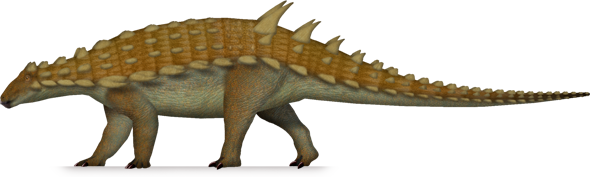
Hylaeosaurus armatus
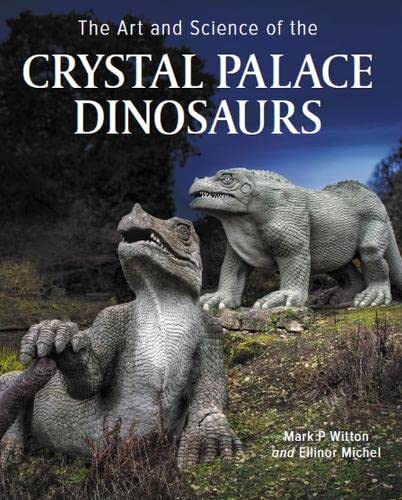
Hylaeosaurus is the misfit among the three critters that Sir Richard Owen used to define Dinosauria in 1842, because its holotype—unlike those of Megalosaurus and Iguanodon—is (1) more than a single bone, and (2) still encased in a sandstone block with only surface fossils available for study at the time. It was rescued from the rubble after a gunpowder explosion had demolished a quarry face in Tilgate Forest in 1832 and pencilled in for announcement by Gideon Mantell four months later to much pomp and ceremony. But, alas, his manuscript was a third too long for scientific publication, so he wrote an entire book, inserted his Hylaeosaurus paper as a standalone chapter, added the epithet "armatus" in order to be recognised as its official author under new nomenclature rules at the advice of Henry De la Beche, and managed to get "The Geology of the South-East of England" published and on the shelves by May of 1833.
Since then, Hylaeosaurus has laid claim to—and been stripped of—fragmentary fossils from mainland England, the Isle of Wight, France, Germany, Romania and Spain, and been bolstered by three species, all of which were previously known as something else, with Hylaeosaurus oweni (Hylaeosaurus armatus), Hylaeosaurus northhamptoni (Regnosaurus) and Hylaeosaurus foxii (Polacanthus) ultimately being shoved right back where they started. The holotype, though, is made of sterner stuff and seemingly unfazed by the assault on its bone-obscuring matrix with chisel, airscribe and chemicals by workers at London's Natural History Museum that released many fossils for closer scrutiny. Unfortunately, they didn't reveal much that we didn't already know.
Since then, Hylaeosaurus has laid claim to—and been stripped of—fragmentary fossils from mainland England, the Isle of Wight, France, Germany, Romania and Spain, and been bolstered by three species, all of which were previously known as something else, with Hylaeosaurus oweni (Hylaeosaurus armatus), Hylaeosaurus northhamptoni (Regnosaurus) and Hylaeosaurus foxii (Polacanthus) ultimately being shoved right back where they started. The holotype, though, is made of sterner stuff and seemingly unfazed by the assault on its bone-obscuring matrix with chisel, airscribe and chemicals by workers at London's Natural History Museum that released many fossils for closer scrutiny. Unfortunately, they didn't reveal much that we didn't already know.
(Armoured lizard of the forest)Etymology
Hylaeosaurus is derived from the Greek "hylaios" (from the forest) and "sauros" (lizard). The name was originally explained by Mantell as meaning "forest lizard" alluding to Tilgate Forest where the first specimen was unearthed. However, he later established the use of hylaeo- as a pun for the geological term "Wealden" (meaning "wood") - which was coined in 1828 by Peter Martin for the Early Cretaceous sands and clays of southern England.
The species epithet, armatus, means "armoured" in Latin.
Discovery
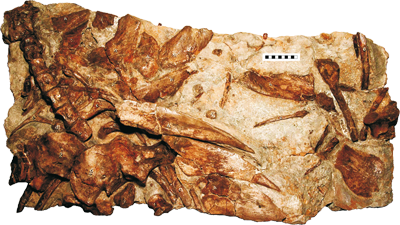 The first remains of Hylaeosaurus were recovered by Gideon Mantell from the Tilgate Grit Member of the Grinstead Clay Formation (Hastings Beds Group), Tilgate Forest, East Sussex, England, after quarry blasting in 1832.
The holotype, NHMUK 3775 (previously BMNH R3775) is a chunk from the front end of a skeleton (vertebrae from the neck and back, ribs, both shoulder girdles, shoulder spines and numerous other osteoderms) and pieces of skull. In 1841, Mantell referred a second specimen to Hylaeosaurus from a layer of "blue clay" near Bolney, West Sussex. According to "the most intelligent of the workmen", a strata of paving stone was removed to reveal "a great number of ribs, vertebrae, and large bones", into which they immediately drove their pickaxes! All that was worth collecting was one "perfect" humerus that turned out to be a left shin (BMNH 2615), a left shoulder blade (BMNH 2584) that Nopcsa used to Frankenstein Polacanthoides ponderosus in 1929, a partial right shoulder blade (BMNH 2620a), a finger bone, and many bashed fragments. Likewise, a third specimen, collected from a quarry at Tilgate Forest by Mantell in 1837, was battered at the hands of labourers, but parts of twenty-six vertebrae, chevrons and armour plates (BMNH 3789) were salvaged. Neither specimen can be assigned to Hylaeosaurus with any confidence, due to a lack of overlapping parts for comparison to the holotype and the presence of another armoured dinosaur — Polacanthus, which is known mostly from a chunk of rear end — in the same areas. Additional remains have been discovered at Sussex and on the Isle of Wight (UK), Westfalen (northwestern Germany), and Ardennes (France), may or may not belong to Hylaeosaurus. But teeth referred to Hylaeosaurus by Owen in 1858 (NHMUK 2310, 3326, 26034, 36488, 43172, R647, R647a and R739) most certainly belong to an indeterminate sauropod. Hylosaurus (Fitzinger, 1843)
Hylaeosaurus owenii (Mantell, 1844)
Polacanthoides ponderosus (Nopcsa, 1928)


