




Pronunciation: YIN-long
Meaning: Hidden dragon
Author/s: Xu, Forster, Clark and Mo (2006)
Synonyms: None known
First Discovery: Xinjiang, China
Acta Ordinal: #609
Yinlong downsi
Discovered by Clark and Xu during their much-publicized National Geographic-sponsored mud pit excavations in the Shishugou Formation of China's Junggar Basin in 2004, Yinlong downsi is the Liquorice Allsorts of Mid-Jurassic ornithischian (bird-hipped) dinosaurs.
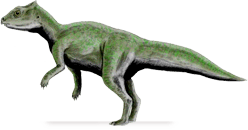
Long, robust hindlimbs and shorter slender forelimbs with three-fingered hands suggests a bipedal lifestyle like many small ornithopods, tightly-packed teeth and features of its braincase resemble those seen in heterodontosaurids, and its skull is capped with a ridge of thickened bone and edged with knobbly outgrowths reminiscent of pachycephalosaurs or "headbangers". But often in paleontology a little thing can make a big difference and the discovery of a tiny bone known as a "rostral"—a component of the skeleton of beaks—told a huge story. Birds aren't the only critters with beaks, you know?
Despite a virtually frill-less and totally horn-less skull, Yinlong is a ceratopsian; the generally frilled and horned or bossed herbivores with beak-tipped snouts for cropping vegetation. Its skull is deep and wide and relatively large compared to most ornithischians but proportionately smaller than most other ceratopsians. It's the only ceratopsian known from Middle Jurassic; a time long before its descendants adopted their hugeness, horned and frilled skulls and were obliged to walk on all fours to support their weight.
Ceratopsians and pachycephalosaurs have long been united in a group called Marginocephalia, but the discovery of Yinlong with its seemingly transitional marginocephalian and heterodontosaurid features prompted Xu et al to coin an all-new family to unite them both—Heterodontosauriformes, which they defined as "the group that includes the most recent common ancestor of Heterodontosaurus and Triceratops and all their descendants". This has yet to find global acceptance though.
Long, robust hindlimbs and shorter slender forelimbs with three-fingered hands suggests a bipedal lifestyle like many small ornithopods, tightly-packed teeth and features of its braincase resemble those seen in heterodontosaurids, and its skull is capped with a ridge of thickened bone and edged with knobbly outgrowths reminiscent of pachycephalosaurs or "headbangers". But often in paleontology a little thing can make a big difference and the discovery of a tiny bone known as a "rostral"—a component of the skeleton of beaks—told a huge story. Birds aren't the only critters with beaks, you know?
Despite a virtually frill-less and totally horn-less skull, Yinlong is a ceratopsian; the generally frilled and horned or bossed herbivores with beak-tipped snouts for cropping vegetation. Its skull is deep and wide and relatively large compared to most ornithischians but proportionately smaller than most other ceratopsians. It's the only ceratopsian known from Middle Jurassic; a time long before its descendants adopted their hugeness, horned and frilled skulls and were obliged to walk on all fours to support their weight.
Ceratopsians and pachycephalosaurs have long been united in a group called Marginocephalia, but the discovery of Yinlong with its seemingly transitional marginocephalian and heterodontosaurid features prompted Xu et al to coin an all-new family to unite them both—Heterodontosauriformes, which they defined as "the group that includes the most recent common ancestor of Heterodontosaurus and Triceratops and all their descendants". This has yet to find global acceptance though.
(Will Downs' Hidden Dragon)Etymology
Yinlong is derived from the Mandarin-Chinese "yin" (hidden) and "long" (dragon), in reference to the kung-fu spectacular 'Crouching Tiger Hidden Dragon' which was partly filmed at Xinjiang, close to its place of discovery.
The species epithet (or specific name), downsi, honors the late Will Downs, a frequent participant in paleontological expeditions to China. Unfortunately, he died the year before Yinlong was discovered.
Discovery
The first remains of Yinlong were discovered in the Upper Shishugou Formation (Qigu Group), Wucaiwan, Junggar Basin, Xinjiang, China, in 2004.
The Holotype (IVPP V14530) is an exceptionally well-preserved skull and skeleton of (probably) a sub-adult (approx. 120 cm long), missing only the end of its tail.


