




Pronunciation: ell-AH-fro-SOR-us
Meaning: Lightweight lizard
Author/s: Janensch (1920)
Synonyms: None known
First Discovery: Kindope, Tanzania
Acta Ordinal: #128
Elaphrosaurus bambergi
On the back of a few scrappy bone fragments stumbled upon in 1906 by mining engineer Bernhard Wilhelm Sattler and the subsequent excavation of "Gigantosaurus" by Sattler and Fraas the following year, a digging party funded by Germany's colonial goverment headed for Tanzania with high hopes.
They employed African locals on a pittance and between bouts of drought, monsoon, maleria and lion attack managed to unearth 250 tons of fossilized remains, then had to crate them up and carry them 50 miles on foot to the Lindi coast for collection.
Those outrageous violations of basic human rights resulted in the biggest haul of Late Jurassic fossils seen outside of the Morrison Formation, and included thousands of remnants of sauropods, stegosaurs and ornithopods. But a bucketfull of teeth and the odd limb bone aside, there was just the one small theropod: Elaphrosaurus, "the lightweight lizard".
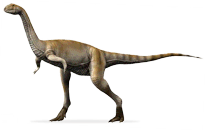
Elaphrosaurus, as the name suggests, was sleek and streamlined with an extremely shallow body for its length, and longer shins than thighs for speedy running. But what made the "lightweight lizard" even more lightweight was the fact that, amongst the quarter of a million kilos of bone-riddled booty removed from the quarry, its skull was nowhere to be found. Being slight of build prompted Janensch to describe Elaphrosaurus as a coelurosaur in 1925, which at that time encompassed any and all small, toothy theropods. But Nopcsa assigned it to Ornithomimidae (1928) because there was no proof that the teeth Janensch assigned here actually belonged here. All was quiet until the 1990s, when more rigorous analyses led to the recognition of this taxa as an archaic ceratosaur closely related to China's Limusaurus and Niger's Spinostropheus, with the three perhaps forming a currently informal clade of swift-running ceratosaurs tagged "elaphrosaurs", though some experts suspect they may be the last of the coelophysoids.
Fossilized footprints, found at Beit Zait village in the Judean Hills just a few kilometers west of Jerusalem by former Hebrew University of Jerusalem geology student Mordechai Sofer in 1962, were identified as being made by an ornithomimid similar to Struthiomimus by Moshe Avnimelech in 1966. Bearing in mind the discovery of Elaphrosaurus in Morocco, Algeria, Tunisia and Egypt, and the fact that Elaphrosaurus was once thought to be an ornithomimid similar to Struthiomimus, Avnimelech couldn't rule out the possibility that Elaphrosaurus was running amok in the holy land too. The imprints are thought to be 90-100 million years old, but don't tell creationists because they'll think you're crazy.
Elaphrosaurus, as the name suggests, was sleek and streamlined with an extremely shallow body for its length, and longer shins than thighs for speedy running. But what made the "lightweight lizard" even more lightweight was the fact that, amongst the quarter of a million kilos of bone-riddled booty removed from the quarry, its skull was nowhere to be found. Being slight of build prompted Janensch to describe Elaphrosaurus as a coelurosaur in 1925, which at that time encompassed any and all small, toothy theropods. But Nopcsa assigned it to Ornithomimidae (1928) because there was no proof that the teeth Janensch assigned here actually belonged here. All was quiet until the 1990s, when more rigorous analyses led to the recognition of this taxa as an archaic ceratosaur closely related to China's Limusaurus and Niger's Spinostropheus, with the three perhaps forming a currently informal clade of swift-running ceratosaurs tagged "elaphrosaurs", though some experts suspect they may be the last of the coelophysoids.
Fossilized footprints, found at Beit Zait village in the Judean Hills just a few kilometers west of Jerusalem by former Hebrew University of Jerusalem geology student Mordechai Sofer in 1962, were identified as being made by an ornithomimid similar to Struthiomimus by Moshe Avnimelech in 1966. Bearing in mind the discovery of Elaphrosaurus in Morocco, Algeria, Tunisia and Egypt, and the fact that Elaphrosaurus was once thought to be an ornithomimid similar to Struthiomimus, Avnimelech couldn't rule out the possibility that Elaphrosaurus was running amok in the holy land too. The imprints are thought to be 90-100 million years old, but don't tell creationists because they'll think you're crazy.
(Bamberg's light-weight Lizard)Etymology
Elaphrosaurus is derived from the Greek "elaphros" (lightweight) and "sauros" (lizard), in reference to its slender build.
The species epithet, bambergi, honours industrialist Paul Bamberg who funded the expedition that found the dinosaur.
Discovery
The first fossils of Elaphrosaurus were discovered at "Quarry dd" in the Middle Saurian Beds of the Tendaguru Formation, Kindope, Lindi Town, 105 kilometers north of Mtwara City, Tanzania, by Werner Janensch and Edwin Hennig between 1909 and 1911.
The holotype (HMN Gr. S. 38-44), is a partial skeleton lacking the skull, forelimbs, ribs, parts of the hip and end of the tail.


