




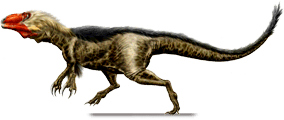
Pronunciation: drip-toe-SOR-us
Meaning: Tearing lizard
Author/s: Marsh (1877)
Synonyms: See below
First Discovery: New Jersey, USA
Acta Ordinal: #47
Dryptosaurus aquilunguis
When attempting to form this creature's miserably poor Barnsboro Quarry remains into something resembling a dinosaur, Edward Drinker Cope attached its eight inch long hand claws to its feet. This gave rise to a mis-leading epithet aquilunguis (eagle-clawed), while the genus was named Laelaps (Storm Wind) after the dog in Greek mythology that never failed in the hunt.
Unfortunately, Cope never never failed to get it right during his dinosaur reconstructions, having previously stuck the head of Elasmosaurus on the end of its tail, and while his latest error may not have been in the same league as his bone-wars-causing cock-up, the embarresment was just as great. Cope's nemesis, Othniel Charles Marsh, jumped at the opportunity to point and laugh... again, especially when he realised Cope's initial name of choice was already taken by a mite (Laelaps agilis, Koch 1838), and to add insult to injury Marsh renamed Laelaps into Dryptosaurus himself in 1877. Oh the shame.
Dryptosaurus was a primitive, long-armed, three(or maybe two)-fingered early tyrannosauroid which was probably the dominant predator of its Early Cretaceous ecosystem. However, it was originally classified as a megalosaurid, later nominated to anchor its own family Dryptosauridae, and later still assigned to Coelurosauria, and it wasn't until the discovery of the similar-in-size but more complete Appalachiosaurus in 2005 that its tyrant lizard affinities, as suspected by Charles W. Gilmore in 1946, were confirmed.
Unfortunately, Cope never never failed to get it right during his dinosaur reconstructions, having previously stuck the head of Elasmosaurus on the end of its tail, and while his latest error may not have been in the same league as his bone-wars-causing cock-up, the embarresment was just as great. Cope's nemesis, Othniel Charles Marsh, jumped at the opportunity to point and laugh... again, especially when he realised Cope's initial name of choice was already taken by a mite (Laelaps agilis, Koch 1838), and to add insult to injury Marsh renamed Laelaps into Dryptosaurus himself in 1877. Oh the shame.
Dryptosaurus was a primitive, long-armed, three(or maybe two)-fingered early tyrannosauroid which was probably the dominant predator of its Early Cretaceous ecosystem. However, it was originally classified as a megalosaurid, later nominated to anchor its own family Dryptosauridae, and later still assigned to Coelurosauria, and it wasn't until the discovery of the similar-in-size but more complete Appalachiosaurus in 2005 that its tyrant lizard affinities, as suspected by Charles W. Gilmore in 1946, were confirmed.
Etymology
Dryptosaurus is derived from the Greek "drypto" (to tear) and "sauros" (lizard).The species epithet, aquilunguis, means "eagle-clawed" in Latin. ZooBank registry: urn:lsid:zoobank.org:act:BD7CC55F-9C44-451D-AF85-AACF40D66CFD.
Discovery
The first remains of Dryptosaurus were discovered in the New Egypt Formation, Barnsboro, Glouchester County, New Jersey, USA, by the crew of J.C Voorhees, employees of the West Jersey Marl Company, in 1866.
Cope named these remains Laelaps in August of the same year, then they were renamed Dryptosaurus by Marsh, which is why some sources list 1866 as its year of description. Fact is; Dryptosaurus didn't exist in 1866, it was coined in July of 1877.
The holotype (ANSP 9995) is an incomplete skeleton.


