




Pronunciation: shin-dee-SOR-us
Meaning: Chinde lizard
Author/s: Long and Murry (1995)
Synonyms: Caseosaurus crosbyensis?
First Discovery: Arizona, USA
Acta Ordinal: #404
Chindesaurus bryansmalli
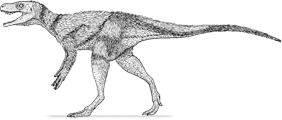
The skull-less partial skeleton of Chindesaurus was discovered at the Navajo Indian-named Chiindii (evil spirit) Point in Arizona's Petrified Forest National Park in 1984, but despite a strictly meat diet and scary connotations it probably wasn't as evil as it sounds.
The type specimen, affectionately known as Gertie, was initially misidentified as a sauropod, but when its actual affinities came into focus, at just over two meters long, it was still something of a midget, even in theropod terms. Still, it was plenty big enough to terrorize small defenceless Triassic mammals and probably found itself on the menu of Saurosuchus in return. The mammals may then have eaten the latter's poop. It's called the circle of death.
A partial hip discovered in the Tecovas Formation of Crosby County was originally assigned to Chindesaurus (Long & Murry, 1995) and travelled all around the small primitive predator family tree before becoming Caseosaurus crosbyensis (Hunt et al. 1998) based upon supposed unique features. Unfortunately, these "unique features" are present on a part of Caseosaurus that has yet to be discovered for Chindesaurus, but some experts believe a full-on synonymy is on the cards, if comparable fossils ever turn up.
The type specimen, affectionately known as Gertie, was initially misidentified as a sauropod, but when its actual affinities came into focus, at just over two meters long, it was still something of a midget, even in theropod terms. Still, it was plenty big enough to terrorize small defenceless Triassic mammals and probably found itself on the menu of Saurosuchus in return. The mammals may then have eaten the latter's poop. It's called the circle of death.
A partial hip discovered in the Tecovas Formation of Crosby County was originally assigned to Chindesaurus (Long & Murry, 1995) and travelled all around the small primitive predator family tree before becoming Caseosaurus crosbyensis (Hunt et al. 1998) based upon supposed unique features. Unfortunately, these "unique features" are present on a part of Caseosaurus that has yet to be discovered for Chindesaurus, but some experts believe a full-on synonymy is on the cards, if comparable fossils ever turn up.
(Bryan Small's Chinde lizard)Etymology
Chindesaurus is derived from the Navajo "Chiindii" ("evil spirit" or "ghost") which was anglicized into "Chinde", and the Greek "sauros" (lizard).The species epithet, bryansmalli, honors Bryan Small, who made the discovery.
Discovery
The fossils of the Chinde lizard were discovered at "Dinosaur Hollow" in the Petrified Forest Member of the Chinle formation (yes, Chinle not Chinde), Petrified Forest National Park, Arizona, USA, by Bryan Small in 1984. It was mixed with the partial skeleton of a shuvosaurid, which is a type of suchian archosaur.
The holotype (PEFO 10395) includes all kinds of vertebrae, a partial left femur and right tibia, a complete right femur, the right ankle, bits of hip and ribs.


