









Pronunciation: tuh-TAN-kuh-SEH-ruh-tops
Meaning: Bison horned face
Author/s: Ott and Larson (2010)
Synonyms: None known
First Discovery: Dakota, USA
Acta Ordinal: #727
Tatankaceratops sacrisonorum
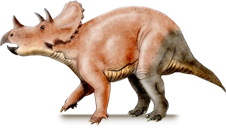
The first bits of Tatankaceratops, a ceratopsian or horn faced herbivore, were discovered in 1997 at Hell Creek. It wasn't officially unveiled until 2010, but bearing in mind paleontologists had 50-odd diagnosable parts and a jigsaw of over 2000 fragments to sort out the delay comes as no surprise.
At just over a meter long some experts strongly suspect that Tatankaceratops is nothing more than a juvenile version of South Dakota's common as muck ceratopsian, Triceratops. However, the authors point to bone fusion (a state/feature that only arrives with adulthood) and features of its 50% complete skull with proportionately different adornments to try and quash this theory.
Relative to body size Tatankaceratops' solid frill was a tad deeper and its face a tad longer (than Triceratops). Its thick, slightly backwards-curving nose horn (much longer than Triceratops) was the same length as its brow horns (much shorter than Triceratops), sprouted from an area completely behind its eye sockets (unlike Triceratops) and weren't as forward-curving. The possibility of a growth disorder has been suggested and island dwarfism (or just plain old dwarfism) was also considered then promptly discounted... because it didn't live on an island. But its place of discovery has raised the odd eyebrow.
Paleontologists have voiced their concerns over the proposed route of the Keystone XL pipeline, set to cut a swathe right through the Ludlow, Valentine and Hell Creek formations and other potentially bone-rich rocks of Montana and South Dakota. The fear is, any fossils stumbled-upon as diggers "rip the area a new one" would be brushed under the carpet in dastardly large corporation fashion, followed by a nauseating shrug of the shoulders as the wheels of profit rumble on.
At just over a meter long some experts strongly suspect that Tatankaceratops is nothing more than a juvenile version of South Dakota's common as muck ceratopsian, Triceratops. However, the authors point to bone fusion (a state/feature that only arrives with adulthood) and features of its 50% complete skull with proportionately different adornments to try and quash this theory.
Relative to body size Tatankaceratops' solid frill was a tad deeper and its face a tad longer (than Triceratops). Its thick, slightly backwards-curving nose horn (much longer than Triceratops) was the same length as its brow horns (much shorter than Triceratops), sprouted from an area completely behind its eye sockets (unlike Triceratops) and weren't as forward-curving. The possibility of a growth disorder has been suggested and island dwarfism (or just plain old dwarfism) was also considered then promptly discounted... because it didn't live on an island. But its place of discovery has raised the odd eyebrow.
Paleontologists have voiced their concerns over the proposed route of the Keystone XL pipeline, set to cut a swathe right through the Ludlow, Valentine and Hell Creek formations and other potentially bone-rich rocks of Montana and South Dakota. The fear is, any fossils stumbled-upon as diggers "rip the area a new one" would be brushed under the carpet in dastardly large corporation fashion, followed by a nauseating shrug of the shoulders as the wheels of profit rumble on.
Etymology
Tatankaceratops is derived from "Tatanka", the Greek "ceras" (horn) and "ops" (face), and could conceivably be a cunning triple-barrelled meaning. "Tatanka" is the Lakota name for the similarly sized American Bison, and is also intended to honor the Lakota Sioux Tribe who inhabited the region where the type specimen was found. The fact that its discoverers - the Sacrison brothers - hail from Buffalo and Bison respectively may be purely coincidental, but they were definately honored in the species epithet, sacrisonorum.
Discovery
Bison horned face was discovered at the Hell Creek Formation of Harding County by Stan and Steve (see above) almost a decade ago as of 2010.
The holotype (BHI6226 - housed at Black Hills Institute, Hill City, South Dakota) is a partial skull.


