





Pronunciation: ob-uh-lig-nath-us
Meaning: Obelix jaw
Author/s: Czepinski and Madzia (2025)
Synonyms: See below
First Discovery: Hérault, southern France
Acta Ordinal: #1200
Obelignathus septimanicus
Discovered in 1990 near Montouliers, the single fossil that would become Obelignathus was assigned to Rhabdodon in 1991 as a second species, Rhabdodon septimanicus, based largely on the similarities of their teeth. Before that, Rhabdodon priscus was the only Rhabdodon species considered valid, and bones from France, Austria, and Romania had all been assigned to it with gay abandon. In the decades that followed, Mochlodon suessi and two species of Zalmoxes—one of which turned out to be a ceratopsian and was renamed Ferenceratops shqiperorum—all broke away from Rhabdodon and did their own thing, and in 2025 that Montouliers fossil—a partial lower jaw—which had always looked out of place, did the same.
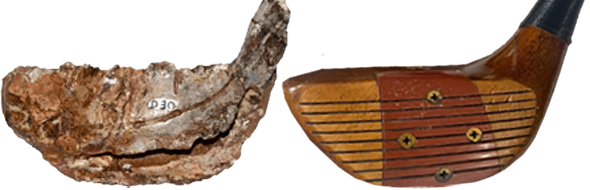
The jaw itself is unusually stout—short, wide, and tall, looking suspiciously like the head of a golf club dipped in Warhammer scatter—and lacks both the outer shelf beside the teeth (buccal platform) and the horizontal ridge normally present at the rear (buccal crest). Its rear upright (coronoid process) sits directly behind the tooth row and is subtly twisted outward and backward, while the inner groove along its base (Meckelian canal) is exceptionally deep, reaching half of the jaw height beneath the tooth row at its thickest point. Those features combined mark Obelignathus as a herbivore with a powerful, specialized chewing style—one adapted for processing tough, fibrous plants within the patchwork of islands that formed the Late Cretaceous European Archipelago.
The jaw itself is unusually stout—short, wide, and tall, looking suspiciously like the head of a golf club dipped in Warhammer scatter—and lacks both the outer shelf beside the teeth (buccal platform) and the horizontal ridge normally present at the rear (buccal crest). Its rear upright (coronoid process) sits directly behind the tooth row and is subtly twisted outward and backward, while the inner groove along its base (Meckelian canal) is exceptionally deep, reaching half of the jaw height beneath the tooth row at its thickest point. Those features combined mark Obelignathus as a herbivore with a powerful, specialized chewing style—one adapted for processing tough, fibrous plants within the patchwork of islands that formed the Late Cretaceous European Archipelago.
(Obelix Jaw of Septimania)Etymology
Obelignathus is derived from "Obélix" (an exceptionally strong Gaul in the French comic series "Asterix" by René Goscinny and Albert Uderzo, in reference to the unusually robust build of the holotype) and the Greek "gnáthos" (jaw). The species epithet, septimanicus, refers to Septimania, a historic region of France corresponding to the former province of Languedoc, in which the holotype quarry at Montouliers is located.
ZooBank registry: urn:lsid:zoobank.org:act:3AB06061-8DE6-4E63-9139-D587A0E30CD9.
Rhabdodon septimanicus (Buffetaut and Le Loeuff, 1991)
Discovery
The remains of Obelignathus were discovered in the Grès à Reptiles Formation at Montouliers, in the Saint-Chinian commune of Hérault, southern France, in 1990.
The holotype (MDE D30) is a partial right lower jaw. The similarly robust "La Boucharde dentary 2", from the La Boucharde site in Bouches-du-Rhône, might belong to Obelignathos. However, it was not available for personal examination before Czepinski and Madzia named Obnelignathus, so it will have to wait for its detailed description.


