






Pronunciation: MAH-puh-SOR-us
Meaning: Earth lizard
Author/s: Coria and Currie (2006)
Synonyms: None known
First Discovery: Neuquén, Argentina
Acta Ordinal: #614
Mapusaurus roseae
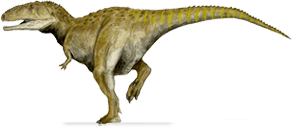
Mapusaurus is known from a hotchpotch of bones from Cañadón del Gato that took five years to excavate, and after implementing the not-so-scientific method of "toe counting", palaeontologists came to the conclusion that they had unearthed a total of seven individuals, ranging in age from juvenile to geriatric.
This congregation of bones could be evidence that Mapusaurus lived as a tribe, hunted as a tribe, and perhaps died as a tribe. But even if the bone pile was nothing more than a coincidental accumulation of carcasses in some long-spanning Late Cretaceous predator trap rather than a hunting party, this was not an ideal time or place to be a herbivore.
Mapusaurus was big and more unique than initially imagined. Because of similarly narrow, blade-like teeth with wrinkled enamel and heavily sculpted facial bones, it was once thought to represent a new species of this area's apex hunter, Giganotosaurus. However, a deeper, shorter face with nobbly but narrow unfused snout bones, slimmer legs, and unpronounceable features of the vertebrae and skull showed that Mapusaurus was a distinct genus, which doubled Neuquen's tally of Tyrannosaurus-rivalling meat munchers, size-wise.
This congregation of bones could be evidence that Mapusaurus lived as a tribe, hunted as a tribe, and perhaps died as a tribe. But even if the bone pile was nothing more than a coincidental accumulation of carcasses in some long-spanning Late Cretaceous predator trap rather than a hunting party, this was not an ideal time or place to be a herbivore.
Mapusaurus was big and more unique than initially imagined. Because of similarly narrow, blade-like teeth with wrinkled enamel and heavily sculpted facial bones, it was once thought to represent a new species of this area's apex hunter, Giganotosaurus. However, a deeper, shorter face with nobbly but narrow unfused snout bones, slimmer legs, and unpronounceable features of the vertebrae and skull showed that Mapusaurus was a distinct genus, which doubled Neuquen's tally of Tyrannosaurus-rivalling meat munchers, size-wise.
(Rose Earth Lizard)Etymology
Mapusaurus is derived from the Mapuche "Mapu" (earth) and the Greek "sauros" (lizard). Mapuche ("earth people") are the indigenous inhabitants of southwest Argentina. The species epithet, roseae, is named for both the rose-colored rocks in which the fossils were found and for Rose Letwin, sponsor of the expeditions which recovered the fossils.
Discovery
The first remains of Mapusaurus were discovered in the Huincul Formation (Rio Limay Group) at Cañadón del Gato in the Cortaderas area, 20 km southwest of Plaza Huincul, Argentina, by members of the Argentine-Canadian Dinosaur Project in 1997.
The Holotype (MCF-PVPH-108.1) is a right nasal (snout bone).
Skull bones (MCF-PVPH-108.5, MCF-PVPH-108.167, MCF-PVPH-108.177), jaw bones (MCF-PVPH-108.179, MCF-PVPH-108.115, MCF-PVPH-108.125), an axis (MCF-PVPH-108.83), the arch of a neck vertebra (MCF-PVPH-108.90), a right upper arm bone (MCF-PVPH-108.45), hip bones (MCF-PVPH-108.128, MCF-PVPH-108.165) and a right calfbone (MCF-PVPH-108.202) were referred here as paratypes.


