




Pronunciation: SAHL-tah-SOR-us
Meaning: Salta lizard
Author/s: Bonaparte and Powell (1980)
Synonyms: Loricosaurus scutatus?
First Discovery: Salta, Argentina
Acta Ordinal: #288
Saltasaurus loricatus
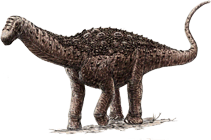
Sheer size was generally enough protection for a sauropod, but Saltasaurus wasn't as big as its lumbering cousins. It was only 12 meters long, with stocky limbs, and weighed a paltry eight tons. Fortunately, Mother Nature can often be relied upon to come to the rescue with work-arounds in such situations, and the odd million-years wait is generally worth it. Evolution tends to weed out weak spots.
For many years, armour scutes from Patagonia had been assigned to ankylosaurs, but palaeontologists were cock-a-hoop when a huge haul of obviously non-ankylosaur remains—representing most parts of the skeleton barring a skull—confirmed what a certain palaeontologist was banging on about as early as 1896: titanosaurs were armoured sauropods. Well, at least some of them.
Amongst the associated but largely disarticulated bones from a number of individuals were palm-sized armour scutes and skin samples riddled with bony osteoderms. It seems the back and flanks of Saltasaurus were fortified with this nobbly armour, and they probably had them from the get-go.
According to Coria and Chiappe, a large titanosaurid nesting ground discovered at Auca Mahuevo in Patagonia was a gathering spot for mothers who "dug holes with their back feet, laid eggs in clutches averaging around 25 eggs each, and buried the nests under dirt and vegetation". The small eggs, about 11–12 cm in diameter, contained fossilised embryos, and even at this early stage skin impressions showed small, bead-like armour scutes arranged in a mosaic.
For many years, armour scutes from Patagonia had been assigned to ankylosaurs, but palaeontologists were cock-a-hoop when a huge haul of obviously non-ankylosaur remains—representing most parts of the skeleton barring a skull—confirmed what a certain palaeontologist was banging on about as early as 1896: titanosaurs were armoured sauropods. Well, at least some of them.
Amongst the associated but largely disarticulated bones from a number of individuals were palm-sized armour scutes and skin samples riddled with bony osteoderms. It seems the back and flanks of Saltasaurus were fortified with this nobbly armour, and they probably had them from the get-go.
According to Coria and Chiappe, a large titanosaurid nesting ground discovered at Auca Mahuevo in Patagonia was a gathering spot for mothers who "dug holes with their back feet, laid eggs in clutches averaging around 25 eggs each, and buried the nests under dirt and vegetation". The small eggs, about 11–12 cm in diameter, contained fossilised embryos, and even at this early stage skin impressions showed small, bead-like armour scutes arranged in a mosaic.
Etymology
Saltasaurus is derived from "Salta" (the Province in which it was discovered) and the Greek "sauros" (lizard).
The species epithet, loricatus,
means "armoured" in Latin.
Synonyms
Loricosaurus scutatus? (von Huene, 1929),
Loricosaurus scutulatus? (von Huene, 1929).
Discovery
The first fossils of Saltasaurus were discovered in the Lecho Formation at "El Brete" Ranch, Salta Province, Argentina, by José Bonaparte between 1975 and 1977.
The holotype (PVL 4017-92) is a partial hip: a pair of ilia fused to a complete sacrum. Thanks to numerous specimens, most of the skeleton is now known.


