





Pronunciation: hun-GAH-ro-SOR-us
Meaning: Hungary lizard
Author/s: Attila Ösi (2005)
Synonyms: None known
First Discovery: Veszprém, Hungary
Acta Ordinal: #583
Hungarosaurus tormai
(Torma's Hungary lizard)Etymology
Hungarosaurus is derived from "Hungary" (the country in which it was discovered) and the Greek "sauros" (lizard).
The species epithet, tormai, honours András Torma, who co-discovered the Iharkút locality in 2000.
Discovery
The remains of Hungarosaurus were discovered in an open-pit bauxite mine in the Csehbánya Formation near the village of Iharkút, Veszprém County, in the Bakony Mountains of western Hungary, by Attila Ösi and András Torma in 2001. The site also contained fossils of fish, amphibians, turtles, crocodiles, lizards, pterosaurs, and every other dinosaur that has ever been found in Hungary.
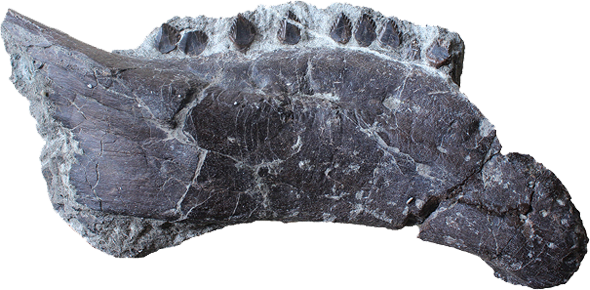
The Hungarosaurus holotype (MTM Gyn/404) is a partial skull and skeleton, including three neck vertebrae, six back vertebrae, ten tail vertebrae, three neck and thirteen back ribs, five chevrons, tendon fragments, a complete left shoulder girdle, a right shoulder blade, a right lower arm bone, four hand bones, a partial pelvis (parts of the left and right ilia and the left ischium), a right thigh, a right shin, and more than a hundred armour plates.
Paratypes include MTM Gyn/405 (one back vertebra, neck and back ribs, some small circular armour scutes, and a piece of neck armour called a "half-ring"), MTM Gyn/406 (a fragmentary lower arm bone, ribs and scutes, and what may be a piece of thigh), and MTM Gyn/407 (a block of hip vertebrae with both ilia and ischia attached, and fused armour plates).
In 2006, three more specimens were discovered, including MTM 2007.25.1–2007.25.30 (a fifth partial skeleton, consisting of two lower jaw bones, several back and tail vertebrae, tendons, a block of hip vertebrae, neck and back ribs, a left shoulder girdle, a right upper arm, two lower arm bones, four hand bones, a partial pelvic girdle, both thighs, a left calf, four foot bones, two toe bones, one claw, three plates from a "half-ring" and several oval, circular or lance-shaped armour plates), and MTM V.2003.12 and MTM 2007.26.4 (two isolated skull bones).


