





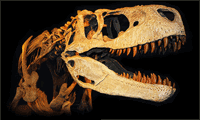
Pronunciation: ap-uh-LACH-ee-o-SOR-us
Meaning: Appalachian lizard
Author/s: Carr et al. (2005)
Synonyms: None known
First Discovery: Alabama, USA
Acta Ordinal: #565
Appalachiosaurus montgomeriensis
Complete sets of carnivorous dinosaur fossils from Appalachia (eastern North America) are almost as rare as chicken teeth, so when theropod fossils just kept on coming from a quarry in Alabama during the 1980s it caused quite a stir. Unfortunately, the final bone count wasn't as high as hoped and dried up at around 45%, but it's still far and away the best-represented Appalachian theropod. Unfused skull bones showed that it was merely a juvenile, but palaeontologists reckoned that it may have measured a very respectable seven meters long in its entirety, and tipped the scales at 600 kg.
Before Appalachiosaurus was even named it was thought to be closely related to the good ol' North American "corpse eater" Albertosaurus sarcophagus to which its remains were once assigned (James Lamb, 1989). But a series of six ridges atop its snout suggested a closer kinship to the Asian tyrannosaurid Alioramus. The analysis that arrived with its christening as a standalone critter in 2005 concluded that Appalachiosaurus was more primitive than Albertosaurus and Alioramus and that it occupied a basal branch within the Tyrannosaurus-anchored tyrannosauroidea. However, it's some way from the size of the Tyrant lizard king, and has a much narrower snout.
Going against the grain of the proportionately short arms and two fingered hands that are typical of large tyrannosaurs, Museums have a habit of mounting their casts of Appalachiosaurus for display with long arms and three fingered hands, even though little of the arms and no fossils from the hands have been discovered. Apparently, that depiction is based solely on the strength of a funny bone (humerus), which is the only Appalachiosaurus forearm material currently known, and even that may belong to a different dinosaur entirely.
Before Appalachiosaurus was even named it was thought to be closely related to the good ol' North American "corpse eater" Albertosaurus sarcophagus to which its remains were once assigned (James Lamb, 1989). But a series of six ridges atop its snout suggested a closer kinship to the Asian tyrannosaurid Alioramus. The analysis that arrived with its christening as a standalone critter in 2005 concluded that Appalachiosaurus was more primitive than Albertosaurus and Alioramus and that it occupied a basal branch within the Tyrannosaurus-anchored tyrannosauroidea. However, it's some way from the size of the Tyrant lizard king, and has a much narrower snout.
Going against the grain of the proportionately short arms and two fingered hands that are typical of large tyrannosaurs, Museums have a habit of mounting their casts of Appalachiosaurus for display with long arms and three fingered hands, even though little of the arms and no fossils from the hands have been discovered. Apparently, that depiction is based solely on the strength of a funny bone (humerus), which is the only Appalachiosaurus forearm material currently known, and even that may belong to a different dinosaur entirely.
(Appalachian lizard from Montgomery County)Etymology
Appalachiosaurus is derived from "Appalachia" (a region of the USA that was named after the Appalachian Mountains) and the Greek "sauros" (lizard). The species epithet, montgomeriensis, is derived from "Montgomery" (the Alabama county in which it was discovered) and the Latin "ensis" (from). During the Mesozoic, Appalachia was the easternmost of two continents (the other was Laramidia) which were separated from each other by the Western Interior Seaway. The Appalachian "region" includes all of West Virginia and parts of twelve other states, mostly the ones whose residents are depicted comically as moonshine-brewing, gumbo-loving, clan-feuding hill-billies.
Discovery
Appalachiosaurus was discovered at the Turnipseed Dinosaur Site (we're not maiking this up!) in the Demopolis Chalk Formation, Montgomery County, Alabama, USA, by Auburn University geologist David King in July 1982.
The holotype (RMM 6670, housed at the McWane Center, Birmingham, Alabama) consists of parts of the skull and mandible (lower jaw), parts of the pelvis, most of both hindlimbs, and some tail vertebrae - two of which were fused together suggesting a healed injury.


