




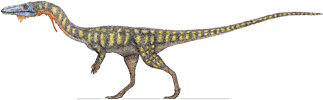
Pronunciation: SEE-lo-FY-sis
Meaning: Hollow Form
Author/s: Cope (1889)
Synonyms: See below
First Discovery: New Mexico, USA
Acta Ordinal: #69
Coelophysis bauri
The first remains of this small, slim, agile theropod were discovered in 1881 at either "Mesa Gallina" or "Arroyo Seco" (exact location data is long lost) by fossil-forager David Baldwin with just his trusty mule for company. Edward Drinker Cope, so utterly underwhelmed, didn't even bother to describe them until 1871, but he made up for lost time when he managed to give the same specimen six different names in less than two years. At first he split its fossils between Marsh's Coelurus longicollis and his newly-coined Coelurus bauri (1887a), then he assigned these two species to the roll-call of Tanystropheus along with a Tanystropheus willistoni (1887b). Only in 1889 did he realise that he had an all new dinosaur on his hands and finally name Coelophysis — "hollow form" — in reference to its hollow bones.
Despite this moving and shaking, Coelophysis was based upon terribly fragmentary remains that were hardly worth the bother, so much so that it was in real danger of being dumped in the dreaded taxonomic dustbin. However, just like waiting for a bus in the rain paleontologists hung around for six decades then a bunch of specimens turned up all at once as George Whitaker found what would escalate into thousands of specimens of all ages at New Mexico's Ghost Ranch aka Coelophysis Quarry aka Whitaker quarry, in 1947, that had perished en masse, possibly the victims of a flash flood or other such naturally occurring disaster, and Edwin Colbert immediately assigned them all to Coelophysis.
Problem is, the name-bearing specimen of Coelophysis (four vertebrae and a piece of hip that was designated as lectotype in the absence of a holotype) was so poorly preserved that a comparison to these new fossils was impossible, plus Whitaker's quarry was many kilometers away from where the type material of Coelophysis was found, so Adrian Hunt and Spencer Lucas gave the new specimens a new name; Rioarribasaurus colberti, in 1991. Despite being honored in the specific name, Colbert was having none of it and petitioned the ICZN to install a spectacular individual from Ghost Ranch as the new type (neotype) to replace his previously chosen surrogate type (lectotype) of Coelophysis based on little more than the laws of probability, and the specimen he chose was catalogued as AMNH 7224, the proposed holotype of Rioarribasaurus Colberti no less! No doubt, Colbert's motive for having Rioarribasaurus chalked off was to legislate his 45 years of error in assigning the Whitaker Quarry theropods to Coelophysis with gay abandon. But never-the-less, the ICZN crawled at a snails pace as it pondered the ramifications of replacing a dubious critter with an outstanding specimen attached to a shiny new name and eventually set its own principles aside by granting Colbert and chums their wish in 1996. Since then, demand has been high.
Coelophysis was given a starring role in the BBC's "walking with dinosaurs" series which catapulted it to super-stardom and a guaranteed place on everyones 'A' list, following its 1981 adoption by New Mexico as their official state fossil and a 1998 trip on Endeavor to visit the Mir space station. Suprisingly, this wasn't the first time a dinosaur had been into space as Maiasaura — the good mother lizard — had a bone fragment and piece of eggshell dragged along on a Spacelab 2 mission in 1995. To this day, the reason for taking dinosaur fossils into space eludes us, and while we're not normally gambling men we're willing to bet it seemed like a brilliant idea to someone at the time.
Despite this moving and shaking, Coelophysis was based upon terribly fragmentary remains that were hardly worth the bother, so much so that it was in real danger of being dumped in the dreaded taxonomic dustbin. However, just like waiting for a bus in the rain paleontologists hung around for six decades then a bunch of specimens turned up all at once as George Whitaker found what would escalate into thousands of specimens of all ages at New Mexico's Ghost Ranch aka Coelophysis Quarry aka Whitaker quarry, in 1947, that had perished en masse, possibly the victims of a flash flood or other such naturally occurring disaster, and Edwin Colbert immediately assigned them all to Coelophysis.
Problem is, the name-bearing specimen of Coelophysis (four vertebrae and a piece of hip that was designated as lectotype in the absence of a holotype) was so poorly preserved that a comparison to these new fossils was impossible, plus Whitaker's quarry was many kilometers away from where the type material of Coelophysis was found, so Adrian Hunt and Spencer Lucas gave the new specimens a new name; Rioarribasaurus colberti, in 1991. Despite being honored in the specific name, Colbert was having none of it and petitioned the ICZN to install a spectacular individual from Ghost Ranch as the new type (neotype) to replace his previously chosen surrogate type (lectotype) of Coelophysis based on little more than the laws of probability, and the specimen he chose was catalogued as AMNH 7224, the proposed holotype of Rioarribasaurus Colberti no less! No doubt, Colbert's motive for having Rioarribasaurus chalked off was to legislate his 45 years of error in assigning the Whitaker Quarry theropods to Coelophysis with gay abandon. But never-the-less, the ICZN crawled at a snails pace as it pondered the ramifications of replacing a dubious critter with an outstanding specimen attached to a shiny new name and eventually set its own principles aside by granting Colbert and chums their wish in 1996. Since then, demand has been high.
Coelophysis was given a starring role in the BBC's "walking with dinosaurs" series which catapulted it to super-stardom and a guaranteed place on everyones 'A' list, following its 1981 adoption by New Mexico as their official state fossil and a 1998 trip on Endeavor to visit the Mir space station. Suprisingly, this wasn't the first time a dinosaur had been into space as Maiasaura — the good mother lizard — had a bone fragment and piece of eggshell dragged along on a Spacelab 2 mission in 1995. To this day, the reason for taking dinosaur fossils into space eludes us, and while we're not normally gambling men we're willing to bet it seemed like a brilliant idea to someone at the time.
(Baur's hollow form)Etymology
Coelophysis is derived from the Greek "koilos" (hollow) and "physis" (form, in nature) in reference to its "hollow" vertebrae and limb bones. The species epithet, bauri, honors vertebrate morphologist Georg Hermann Carl Lugwig Baur, one of the many collectors who provided E.D. Cope (the coining author) with fossils.
Tooth variation
Erecting new taxa based solely on isolated theropod teeth has been occuring since fossil records began, but the results of a 2014 study by Lisa Buckley and Phil Currie confirmed that this practice is not such a good one, even for teeth with seemingly "unique" features. They studied 848 teeth from 23 skulls of Coelophysis bauri and found that those from smaller specimens differed significantly in size, shape and features compared to those of larger ones. Even teeth from the same mouth showed distinct variation depending on where they were positioned in the jaw, meaning thousands of loose teeth may have been misassigned down the years.


