




Pronunciation: noh-throh-NI-kus
Meaning: Sloth claws
Author/s: Kirkland and Wolfe (2001)
Synonyms: None known
First Discovery: New Mexico, USA
Acta Ordinal: #494
Nothronychus mckinleyi
Unbeknown to palaeontologists working at New Mexico's Haystack Butte, they had already discovered the first remains of Nothronychus five years before it was named. But they mistook a hip bone (ischium) for a cheekbone (squamosal) and had assigned it to
Zuniceratops, the oldest known ceratopsian from North America.
After further discoveries in the same area, Kirkland and Wolf coined Nothyronychus, who took ownership of said hip bone. Then it trumped Zuniceratops by being the first definitive therizinosaur from outside of Asia and the most complete therizinosaur known from anywhere in the world, and blew minds by sporting a weird suite of features that experts would never have put together had they not found them all rolled into a single skeleton.
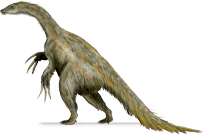
Thanks to Nothyronychus, we now know that all therizinosaurids had leaf-shaped teeth in a small skull set on a long neck, short, stocky legs with three-toed feet, and three huge hand claws for which they (the "reaping lizards") were named. They're weird on the inside also, with aero-textured vertebrae and a large, tilted, sloth-like pelvis with a backwards-pointing ornithischian-style pubis to accommodate an enormous pot belly. Therizinosaurids were vegetarians, probably, yet compared to all other herbivores, they had a very short tail. But perhaps the most unusual thing about them is that they were coelurosaurian theropods: the branch of saurischian dinosaurs renowned for their fondness of flesh.
After further discoveries in the same area, Kirkland and Wolf coined Nothyronychus, who took ownership of said hip bone. Then it trumped Zuniceratops by being the first definitive therizinosaur from outside of Asia and the most complete therizinosaur known from anywhere in the world, and blew minds by sporting a weird suite of features that experts would never have put together had they not found them all rolled into a single skeleton.
Thanks to Nothyronychus, we now know that all therizinosaurids had leaf-shaped teeth in a small skull set on a long neck, short, stocky legs with three-toed feet, and three huge hand claws for which they (the "reaping lizards") were named. They're weird on the inside also, with aero-textured vertebrae and a large, tilted, sloth-like pelvis with a backwards-pointing ornithischian-style pubis to accommodate an enormous pot belly. Therizinosaurids were vegetarians, probably, yet compared to all other herbivores, they had a very short tail. But perhaps the most unusual thing about them is that they were coelurosaurian theropods: the branch of saurischian dinosaurs renowned for their fondness of flesh.
(Bobby McKinley's sloth-like claw)Etymology
Nothronychus is derived from the Greek "nothros" (slothful) and "onyx" (claw), named for the large, groundsloth-like claws on its hands.
The species epithet, mckinleyi (muh-KIN-lee-ie), honors rancher and research supporter Bobby McKinley, on whose land the specimen was found.
Discovery
The first remains of Nothronychus were discovered at "Haystack Butte" in the Moreno Hill Formation, Zuni Basin, Catron County, west-central New Mexico, mingled with the remains of Zuniceratops in 1996. However, it wasn't named until further discoveries were made in the same area in 2001.
The holotype (MSM P-2117) consists of two skull fragments, a braincase, some vertebrae and parts of the shoulder, forelimbs, pelvis and hindlimbs.


