STEGOSAURUS
a plant-eating stegosaurine dinosaur from the Late Jurassic of North America.
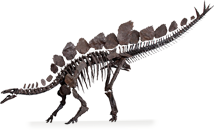
Pronunciation: STEG-o-SOR-us
Meaning: Roof lizard
Author/s: Marsh (
1877)
Synonyms: See
below
First Discovery: Colorado, USA
Acta Ordinal: #50
Stegosaurus stenops
(Armoured roof lizard)Etymology
Stegosaurus is derived from the Greek " stego" (cover, roof)" and "sauros" (lizard).
The
species epithet,
armatus, means "equipped with armour" in Latin.
ZooBank registry:
urn:lsid:zoobank.org:act:A3209EE4-2A3A-4FD8-82D0-ED9DC898FB89.
Hypsirophus (Cope, 1879),
Diracodon (Marsh, 1881).
Discovery
The first
Stegosaurus remains were discovered at "Saurian Quarry 5" in the Morrison Formation, north of Morrison Town, Jefferson County, Colorado, USA, by Professor Arthur Lakes and U. S. Navy Engineer H. C. Beckwith in 1877.
The
holotype (YPM 1850), "coaxed" from the ground with hammers, chisels, and explosives, is understandibly fragmentary and may include remains that actually belong to
Allosaurus and
Diplodocus! With this in mind, Peter Galton, in 2010, proposed that this holotype not only be replaced by a better one, but one belonging to a completely different species of
Stegosaurus—USNM 4934,
Stegosaurus stenops (Marsh, 1887)—which is known from dozens of well-preserved specimens. The ICZN concurred in 2013.
Best form of defence is attack
Though often portrayed as lumbering plant eaters,
Stegosaurus were no pushovers according to experts who have uncovered evidence of a casualty of stegosaurian combat. Apparently. The smoking gun is a fatal stab wound—conical in shape and matching a stegosaur tail spike—found in the pubis bone of an
Allosaurus, and such was the angle of entry that the perpetrator would have had to sweep its tail under the predator, twist the tail tip and then strike upwards, because the spikes on the end of a stegosaur's tail, known as a "thagimizer", point sideways and backwards. So there you go.
Stegosaurus were dumb yet dextrous.
Estimations
Timeline:
Era: Mesozoic
Epoch: Late Jurassic
Stage: Kimmeridgian
Age range: 156-151 mya
Stats:
Est. max. length: 9 meters
Est. max. hip height: 3 meters
Est. max. weight: 3 tons
Diet: Herbivore
Other valid species
Stegosaurus sulcatus—"furrowed roof lizard"—was described by Marsh in 1887 based on a partial skeleton, but it may be a synonym of
Stegosaurus armatus.
Stegosaurus ungulatus—"hoofed roof lizard"—was named by Marsh in 1879 for a few vertebrae and armor plates from Como Bluff, Wyoming. It may represent a juvenile form of
Stegosaurus armatus, but this didn't deter Escaso
et al. from assigning a Portuguese specimen here well over a century later, which makes it the first and so far only
confirmed Stegosaurus specimen known from outside of North America, regardless of which species it represents.
...and not so much
Stegosaurus affinis—"Related roof lizard"—is only known from a pubis found in "Quarry 13" at Como Bluff which was never illustrated and only poorly described by O.C. Marsh in 1881. It was never assigned a specimen number either, and its remains appear to be lost. It may be synonymous with
Stegosaurus armatus.
Stegosaurus seeleyanus—"Seeley's roof lizard"—was originally named
Hypsirophus seeleyanus, a second species of Hypsirophus—which isn't a Scooby Doo typo of
Hypsilophus—by E.D. Cope in 1879. Although never illustrated or actually described, E.D. Cope renamed its
Stegosaurus seeleyanus later the same year, though its remains probably belong to
Stegosaurus armatus.
Stegosaurus laticeps—"Broad-headed roof lizard"—was originally described by Marsh in 1881 as
Diracodon (neck-point tooth) based on some jawbone fragments.
Following a 70s/80s trend of combining dinosaur names—
Edmontonia (
Chassternbergia)
rugosidens,
Panoplosaurus (Edmontonia) longiceps, and so on—Bob Bakker semi-resurrected
Diracodon laticeps as
Stegosaurus (
Diracodon)
laticeps in 1986, though most paleontologists consider the material to be non-diagnostic and likely synonymous with
Stegosaurus stenops.
Stegosaurus duplex—"two plexus roof lizard" (YPM 1858)— started the "two brained" theory. Collected in 1879 by Edward Ashley at Como Bluff but not named until 1887, a greatly enlarged canal in its sacrum (YPM 1857) was interpreted by O.C Marsh as a "posterior brain case". It's probably the same as
Stegosaurus armatus, though Marsh initially thought it belonged to
Stegosaurus ungulatus.
Stegosaurus madagascariensis—"Madagascan roof lizard"—was described by Piveteau in 1926 based solely on teeth that have variously been identified as the property of a theropod (probably
Majungasaurus), a hadrosaur and a crocodylian.
Stegosaurus marshi—"Marsh's roof lizard"—was named and described briefly by Lucas in 1901 based on a mangled skeleton found by Nelson Horatio Darton at Buffalo Gap Station in the Lakota Formation of Custer County, South Dakota, in 1898. It was renamed
Hoplitosaurus by Lucas in 1902 and fully described by Gilmore in 1914, but continues to court controversy.
Stegosaurus priscus—"Ancient roof lizard"—was described by Nopcsa in 1911. It was reassigned to
Lexovisaurus by Galton in 2004, but is now the type species of
Loricatosaurus.
Stegosaurus longispinus (Gilmore, 1914) was controversially renamed
Natronasaurus longispinus by Ulansky in 2014... which was controversially renamed
Alcovasaurus by Galton and Carpenter in 2016.
Funnily enough, during a cull of stegosaurids by Maidment in 2008, she put down her scythe long enough to raise two
Stegosaurus species of her own, though few experts have accepted them:
Stegosaurus mjosi, based on a critter previously known as
Hesperosaurus mjosi
and
Stegosaurus homheni, based on a critter long known as
Wuerhosaurus homheni.
References
• Marsh OC (1877) "
A new order of extinct Reptilia (Stegosauria) from the Jurassic of the Rocky Mountains".
• Marsh OC (1887) "Principal characters of American Jurassic dinosaurs - Part IX
- The skull and dermal armor of Stegosaurus".
• Weishampel DB and White NM (2003) "
The Dinosaur Papers (1676-1906)".
• Ostrom JH and McIntosh JS (2000) "
Marsh's Dinosaurs: The Collections from Como Bluff".
• Carpenter K (2001) "
The Armored Dinosaurs (life of the past)".
• Galton PM (2010) "Species of plated dinosaur
Stegosaurus (Morrison Formation, Late Jurassic) of western USA: new type species designation needed".
•
Escaso F, Ortega F, Dantas P, Malafaia E, Pimentel NL, Pereda-Suberbiola X, Sanz JL, Kullberg JC, Kullberg MC, Barriga F. (2007) "New Evidence of Shared Dinosaur Across Upper Jurassic Proto-North Atlantic:
Stegosaurus From Portugal".
• Maidment SCR, Norman DB, Barrett PM and Upchurch P (2008) "Systematics and phylogeny of Stegosauria (Dinosauria: Ornithischia)".
Journal of Systematic Palaeontology 6 (4): 367–407.
• Saitta ET (2015) "
Evidence for Sexual Dimorphism in the Plated Dinosaur Stegosaurus mjosi (Ornithischia, Stegosauria) from the Morrison Formation (Upper Jurassic) of Western USA".
• Maidment SCR, Brassey C and Barrett PM (2015) "
The Postcranial Skeleton of an Exceptionally Complete Individual of the Plated Dinosaur Stegosaurus stenops (Dinosauria: Thyreophora) from the Upper Jurassic Morrison Formation of Wyoming, U.S.A.".
PLoS ONE 10(10): e0138352. doi:10.1371/journal.pone.0138352.
• Buffetaut E (2023) "
The first life reconstructions of Stegosaurus and Camptosaurus".
Historia Natural, Tercera Serie, 13(1): 21-133.
Time stands still for no man, and research is ongoing. If you spot an error, or want to expand, edit or add a dinosaur, please use
this form. Go
here to contribute to our FAQ.
All dinos are GM free, and no herbivores were eaten during site construction!
To cite this page:
Atkinson, L.
"
STEGOSAURUS :: from DinoChecker's dinosaur archive".
‹
http://www.dinochecker.com/dinosaurs/STEGOSAURUS›. Web access: 09th Sep 2026.