




Pronunciation: yuhr-go-VOO-chee-uh
Meaning: Coyote
Author/s: Senter et al. (2012)
Synonyms: None known
First Discovery: Utah, USA
Acta Ordinal: #817
Yurgovuchia Doellingi
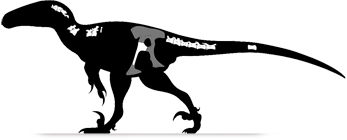
Dromaeosauridae is a diverse family of predatory dinosaurs, a point driven home in 2012 when Senter and colleagues described three new dromaeosaurid specimens from Utah’s Yellow Cat Member. Only one, however, preserved enough diagnostic material to earn an official name: Yurgovuchia doellingi (Helmut Doelling's Coyote). Modest in size, hailing from the same area, and sporting several features in common with Utahraptor, it would be tempting to assume that Yurgovuchia was simply a juvenile version of, well, Utahraptor, but its vertebrae tell a different story. The neurocentral sutures — flexible, cartilage-based joints that remain open in young animals but fuse into solid bone once growth is complete — are fully closed, marking it as an adult, and those adult vertebrae revealed something unexpected about its tail.
Most known "raptor" tails acted as dynamic stabilisers during running and attack, stiffened by a sheath of long, interwoven bony struts (prezygapophyses) that formed a structure known as a "caudotheca", while others—such as unenlagiines—lacked this stiffening entirely. Yurgovuchia fell between these extremes, with medium length struts creating a tail that was partly rigid yet still capable of flexion. And while it might appear to be a halfway house on a one-way street to stiff-tailed-ness, evolution is never that simple. The semi?stiff tail—a feature called a “hemicaudotheca”—is, in effect, a backwards step within dromaeosaurines, with Yurgovuchia the early architect of a trait that would precede, and perhaps enable, the evolution of its gigantic kin—Achillobatar and Utahraptor—tens of millions of years later. Larger bodies needed greater tail flexibility to maintain balance during vigorous movement, and a hemicaudotheca, being less rigid than a full caudotheca, offered exactly that.
Most known "raptor" tails acted as dynamic stabilisers during running and attack, stiffened by a sheath of long, interwoven bony struts (prezygapophyses) that formed a structure known as a "caudotheca", while others—such as unenlagiines—lacked this stiffening entirely. Yurgovuchia fell between these extremes, with medium length struts creating a tail that was partly rigid yet still capable of flexion. And while it might appear to be a halfway house on a one-way street to stiff-tailed-ness, evolution is never that simple. The semi?stiff tail—a feature called a “hemicaudotheca”—is, in effect, a backwards step within dromaeosaurines, with Yurgovuchia the early architect of a trait that would precede, and perhaps enable, the evolution of its gigantic kin—Achillobatar and Utahraptor—tens of millions of years later. Larger bodies needed greater tail flexibility to maintain balance during vigorous movement, and a hemicaudotheca, being less rigid than a full caudotheca, offered exactly that.
Etymology
Yurgovuchia honours the Ute Tribe of northeastern Utah and is derived from the word they use to refer to "Coyote" (yogho-vu-chi), which is a modern day predator from the same region. In Ute folklore, Coyote is a trustless, unreliable, lying trickster and the literal meaning of yogho-vu-chi is far from complimentary. We couldn't possibly print it here but think of Ben Stiller's 2012 movie "Little Fockers"... then change the "o" to a "u" and drop the "s". The species epithet, Doellingi, honours Helmut Doelling in recognition of his half-century of geological research in Utah. The Doelling's Bowl dinosaur sites, also named in Helmut's honour, were discovered as a result of taping together colour photocopies of his then-unpublished geological maps of the area, thus providing a layout of the entire Arches National Park region. ZooBank registry: urn:lsid:zoobank.org:act:8C781C52-96FF-4377-A337-82FC875DC24E.
Discovery
The remains of Yurgovuchia were discovered at "Don's Place" (part of the Doelling's Bowl bone bed) in the Lower Yellow Cat Member of the Cedar Mountain Formation, Grand County, Utah, by Don DeBlieux in 2005.The holotype (UMNH VP 20211) consists of neck (cervical), back (dorsal) and tail (caudal) vertebrae, and a partial hip (left pubis).


