




Pronunciation: ZOO-nee-SEH-ruh-tops
Meaning: Zuni horned face
Author/s: Wolfe and Kirkland (1998)
Synonyms: None known
First Discovery: New Mexico, USA
Acta Ordinal: #440
Zuniceratops christopheri
Like a stick to the eye of professional paleontologists who spend most of their lives scouring barren badlands in the hope of finding a new species of dinosaur, Zuniceratops was discovered by Christopher James Wolfe (son of fossil-jock Douglas G. Wolfe) in the Moreno Hill Formation of west-central New Mexico at the ripe old age of eight. Yes, eight.
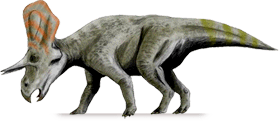
In contrast to its discoverer's tender age, Zuniceratops—from rocks dated to roughly 90 mya—is the oldest ceratopsian known to possess prominent and perky brow horns. It also had a long, low snout and large, bony neck frill (though it lacked a scalloped edge), which are both common features in a group of specialist ceratopsids known as chasmosaurines. But Zuniceratops can't be a ceratopsid because it appears to have single-rooted teeth, and ceratopsids, and thus chasmosaurines, are renowned for their double-rooted teeth. It is, however, on the same path as ceratopsids -- the neoceratopsian path -- but it lacked staying power and died out before the ceratopsids evolved.
Zuniceratops was small compared to its later-living relatives. But even so, it was big enough to cast doubts on a long-held ceratopsian origin theory by being as old as the oldest one found anywhere else—Asia's Turanoceratops. Based on current fossilized evidence, it's as likely that ceratopsians rose in America then branched into Asia as it is the other way round, because both continents boast unique species that are roughly the same age. That said, as North America became a ceratopsid hotspot and Asia didn't, a North American origin seems more likely. Isolated but comparable teeth from even older North American strata are also doing their bit for team U.S.A.
In contrast to its discoverer's tender age, Zuniceratops—from rocks dated to roughly 90 mya—is the oldest ceratopsian known to possess prominent and perky brow horns. It also had a long, low snout and large, bony neck frill (though it lacked a scalloped edge), which are both common features in a group of specialist ceratopsids known as chasmosaurines. But Zuniceratops can't be a ceratopsid because it appears to have single-rooted teeth, and ceratopsids, and thus chasmosaurines, are renowned for their double-rooted teeth. It is, however, on the same path as ceratopsids -- the neoceratopsian path -- but it lacked staying power and died out before the ceratopsids evolved.
Zuniceratops was small compared to its later-living relatives. But even so, it was big enough to cast doubts on a long-held ceratopsian origin theory by being as old as the oldest one found anywhere else—Asia's Turanoceratops. Based on current fossilized evidence, it's as likely that ceratopsians rose in America then branched into Asia as it is the other way round, because both continents boast unique species that are roughly the same age. That said, as North America became a ceratopsid hotspot and Asia didn't, a North American origin seems more likely. Isolated but comparable teeth from even older North American strata are also doing their bit for team U.S.A.
(Christopher Wolfe's Zuni horn face)Etymology
Zuniceratops is derived from "Zuni" (descendants of the prehistoric Pueblo peoples whose ancestral homeland includes the region where its remains were discovered), and the Greek "ceras" (horn) and "ops" (face).The species epithet, christopheri (kris-TOF-e-rie), is named for Christopher James Wolfe who made the discovery.
Discovery
The first fossils of Zuniceratops were discovered at "Haystack Butte" in the Moreno Hill Formation, Catron County, west-central New Mexico on November 11, 1996.
The holotype (MSM P2101) is a partial fragmentary skeleton. Hundreds of fragments from a second, nearby bonebed included a "Zuniceratops" cheek bone (squamosal) that turned out to be a hip bone (ischium) belonging to North America's first therizinosaurid; Nothronychus, and what were originally identified as snout horn fragments that were no such thing.


