








Pronunciation: TEE-uh-mat
Meaning: For Tiamat
Author/s: Pereira et al. (2024)
Synonyms: None known
First Discovery: Ceará state, Brazil
Acta Ordinal: #1160
Tiamat valdecii
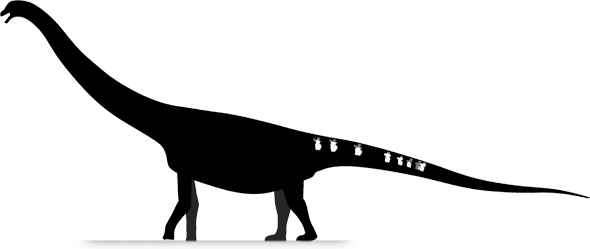
Tiamat valdecii hails from Ceará State in northeastern Brazil and holds the distinction of being the first Early Cretaceous-aged titanosaur known from the Açu Formation and the first dinosaur species described from the entire Potiguar Basin. It is represented mostly by a series of tail vertebrae that preserve features palaeontologists assumed had emerged gradually over the course of titanosaur evolution, and thus offered a rare glimpse into the group's earliest history in South America.
The tail vertebrae show an unusual joint structure: the zygapophyses—the small articular surfaces linking one vertebra to the next—bear extra ridges and deep hollows that help the joints stay aligned during movement. This biomechanical masterstroke made the tail resistant to shear force and dislocation while still allowing it to swing broadly from side to side, giving the animal a tail that was both strong and flexible, and well suited to stabilising a long-bodied sauropod.
The tail vertebrae show an unusual joint structure: the zygapophyses—the small articular surfaces linking one vertebra to the next—bear extra ridges and deep hollows that help the joints stay aligned during movement. This biomechanical masterstroke made the tail resistant to shear force and dislocation while still allowing it to swing broadly from side to side, giving the animal a tail that was both strong and flexible, and well suited to stabilising a long-bodied sauropod.
(For Tiamat and Valdeci)Etymology
Tiamat is named after the mythical Mesopotamian goddess; personification of the primordial sea, consort of Apsu, and "mother of monsters".The species epithet, valdecii [val-DEH-see-eye], honours Brazilian archaeologist Dr Valdeci dos Santos Júnior of Universidade Estadual do Rio Grande do Norte, for the discovery of the fossil site and for his support during the fieldwork. ZooBank registry: urn:lsid:zoobank.org:act:549071C9-46D4-42D0-BE6E-6111110C0B09.
Discovery
The remains of Tiamat were discovered in the Açu Formation of the Potiguar Basin near Limoeiro do Norte, Ceará State, northeastern Brazil, by Valdeci dos Santos Júnior.The holotype consists of seven tail vertebrae (UFRJ-DG 636-R, UFRJ-DG 638-R, UFRJ-DG 606-R, UFRJ-DG 635-R, UFRJ-DG 591-R, UFRJ-DG 527-R, UFRJ-DG 704-R) and a partial neural arch (UFRJ-DG 574-R). An isolated osteoderm (UFRJ-DG 549-R), found in the same formation and described by Pereira et al. in 2018, might belong to Tiamat.


