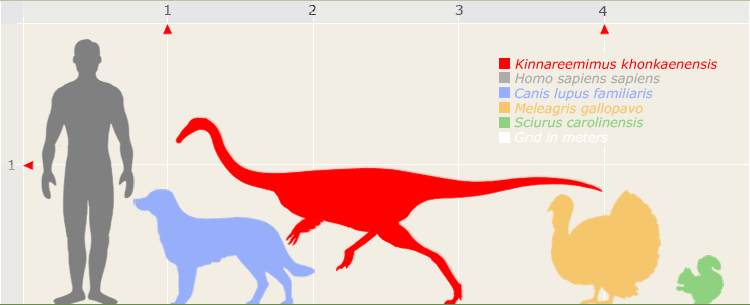


Pronunciation: KIN-ah-ree-MIEM-us
Meaning: Kinnaree mimic
Author/s: Buffetaut et al. (2009)
Synonyms: None known
First Discovery: Phu Wiang, Thailand
Acta Ordinal: #675
Kinnareemimus khonkaenensis
Kinnareemimus was first named (but not described) in a 1999 paper by Sasithorn Kamsupha, who announced it as one of the earliest known ornithomimosaurs, if not the earliest. However, he based his claim on the assumption that its place of discovery—the Sao Khua, which is currently the most fruitful dinosaur-bearing rock formation in Thailand—had been correctly dated to the Late Jurassic.
Unfortunately, the Sao Khua was recently redated, the previous estimate was some 15 million years wide of the mark, and this pulled Kinnareemimus into the Early Cretaceous, which wasn't a total disaster. Along with Harpymimus, Hexing and Pelecanimimus, Kinnareemimus is still amongst the most archaic of its ilk. It just isn't the oldest, which shot holes in the "ornithomimosaurs rose in Asia" theory that was just beginning to gather a head of steam.
Kinnareemimus is represented by just a few isolated parts, but those parts include an arctometatarsus: a feature of the foot whereby the middle of three metatarsals (the bones that join the toes to the ankle) is "pinched" between the flanking pair at the top end. Troodontids, tyrannosauroids and caenagnathids all sport variations of this feature, which seems to be an adaptation for swift running. However, ornithomimosaurs—the herbivorous theropod dinosaurs that are affectionately known as "ostrich mimics"—may be the swift-runniest of them all.
Unfortunately, the Sao Khua was recently redated, the previous estimate was some 15 million years wide of the mark, and this pulled Kinnareemimus into the Early Cretaceous, which wasn't a total disaster. Along with Harpymimus, Hexing and Pelecanimimus, Kinnareemimus is still amongst the most archaic of its ilk. It just isn't the oldest, which shot holes in the "ornithomimosaurs rose in Asia" theory that was just beginning to gather a head of steam.
Kinnareemimus is represented by just a few isolated parts, but those parts include an arctometatarsus: a feature of the foot whereby the middle of three metatarsals (the bones that join the toes to the ankle) is "pinched" between the flanking pair at the top end. Troodontids, tyrannosauroids and caenagnathids all sport variations of this feature, which seems to be an adaptation for swift running. However, ornithomimosaurs—the herbivorous theropod dinosaurs that are affectionately known as "ostrich mimics"—may be the swift-runniest of them all.
(Kinnaree mimic from Khon Kaen)Etymology
Kinnareemimus is derived from "Kinnaree" (creatures of the legendary Himmapan Forest in Thai mythology with the body of a woman but the legs of a bird) and the Latin "mimus" (mimic), alluding to this critter's "bird-like" feet. Although first mentioned in a 1999 paper by Sasithorn Kamsupha and referred to as Ginnareemimus in a publication by Ryuichi Kaneko in 2000, neither included a description, so Eric Buffetaut, who officially described its remains in 2009, is credited as official author.
The species epithet, khonkaenensis, means "from Khon Kaen" in Latin.
Discovery
The remains of Kinnareemimus were discovered in the Sao Khua Formation (Khorat Group) at Phu Wiang, Khon Kaen, which is the second-largest of Thailand's north-eastern Provinces.
The holotype (PW5A-100) is an incomplete left third metatarsal.
Referred material includes two complete metatarsals and eight fragments, eight toe bones, complete left and right shins and a partial left calf, two partial hip bones (left and right pubes), a partial back vertebra and seven partial tail vertebrae.