




Pronunciation: ag-uh-THAW-mas
Meaning: Great wonder
Author/s: E.D. Cope (1872)
Synonyms: None known
First Discovery: Wyoming, USA
Acta Ordinal: #35
Agathaumas sylvestris
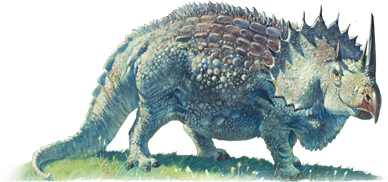
Discovered in 1872 by Fielding Meek and Henry Bannister while scouring the Lance Formation (then called the Laramie) for fossil shells during Ferdinand Hayden's Geological Survey of the territories, Agathaumas sylvestris—"equal in size to the largest known terrestrial saurians and mammals" and, at that time, the largest land animal known to have lived in North America—came as quite a surprise.
Its name, meaning "Great Wonder of the forest", was coined later that same year by an excited Edward Drinker Cope on the strength of a legless rear-end that he initially compared to Hadrosaurus and Dryptosaurus, and then to Cetiosaurus. In fact, the only type of "saurian" he didn't compare it to was a ceratopsid (horn-faced dinosaur), and there's a simple enough reason for that: no horn-faced dinosaur had yet been discovered.
Cope's soon-to-be Bone Wars nemesis, Othniel Charles Marsh of Yale University, was the first to realise horn-faced dinosaurs existed as he coined Ceratops horridus for some skull fossils from the Laramie in 1888. That epiphany led to the realisation that his Ceratops montanus, found by John Bell Hatcher near Montana's Cow Creek the previous year, had a horned face too, and that Bison alticornis, named the year before that, wasn't actually a huge Pliocene-aged Bison after all. With three of these strange beasts in hand, Marsh had enough relatives to erect Ceratopsidae to house them, but not without resistance. Citing the fragmentary nature of Ceratops and unconvinced it differed meaningfully from the remains he had named Agathaumas seventeen years earlier, Cope insisted on calling this family Agathaumidae.
Bison was shunted into Ceratops later in 1889, while Ceratops horridus became the holotype of Triceratops. And based on the size, shape and proportions, Agathaumas is probably Triceratops too. Strictly speaking, Cope's animal should have had priority because it was named first, but there are three reasons why that was never going to happen: (1) it isn't 100% certain that Agathaumas and Triceratops are the same, (2) you can't replace the holotype of a horn-faced critter with a specimen that doesn't actually have a face, never mind a face with horns on it, and (3) the definitive 1907 monograph on horned dinosaurs was written by Marsh and his buddies from Yale. Old Cope was on a hiding to nothing, leaving his Agathaumas sylvestris as little more than a historical curiosity. But he had the last laugh in 1897 when supervising paleoartist Charles Robert Knight during his now-famous painting of a horned and armoured dinosaur for an article in The Century Magazine: a chimaera that was named "Agathaumas sphenocerus", assembled from several dinosaurs, none of which were Agathaumas.
Its name, meaning "Great Wonder of the forest", was coined later that same year by an excited Edward Drinker Cope on the strength of a legless rear-end that he initially compared to Hadrosaurus and Dryptosaurus, and then to Cetiosaurus. In fact, the only type of "saurian" he didn't compare it to was a ceratopsid (horn-faced dinosaur), and there's a simple enough reason for that: no horn-faced dinosaur had yet been discovered.
Cope's soon-to-be Bone Wars nemesis, Othniel Charles Marsh of Yale University, was the first to realise horn-faced dinosaurs existed as he coined Ceratops horridus for some skull fossils from the Laramie in 1888. That epiphany led to the realisation that his Ceratops montanus, found by John Bell Hatcher near Montana's Cow Creek the previous year, had a horned face too, and that Bison alticornis, named the year before that, wasn't actually a huge Pliocene-aged Bison after all. With three of these strange beasts in hand, Marsh had enough relatives to erect Ceratopsidae to house them, but not without resistance. Citing the fragmentary nature of Ceratops and unconvinced it differed meaningfully from the remains he had named Agathaumas seventeen years earlier, Cope insisted on calling this family Agathaumidae.
Bison was shunted into Ceratops later in 1889, while Ceratops horridus became the holotype of Triceratops. And based on the size, shape and proportions, Agathaumas is probably Triceratops too. Strictly speaking, Cope's animal should have had priority because it was named first, but there are three reasons why that was never going to happen: (1) it isn't 100% certain that Agathaumas and Triceratops are the same, (2) you can't replace the holotype of a horn-faced critter with a specimen that doesn't actually have a face, never mind a face with horns on it, and (3) the definitive 1907 monograph on horned dinosaurs was written by Marsh and his buddies from Yale. Old Cope was on a hiding to nothing, leaving his Agathaumas sylvestris as little more than a historical curiosity. But he had the last laugh in 1897 when supervising paleoartist Charles Robert Knight during his now-famous painting of a horned and armoured dinosaur for an article in The Century Magazine: a chimaera that was named "Agathaumas sphenocerus", assembled from several dinosaurs, none of which were Agathaumas.
(Great Wonder of the Forest)
Etymology
Agathaumas is derived from the Greek "agan" (great, much) and "thauma" (wonder), alluding to its great size. The species epithet, sylvestris, meaning !"forest" in Latin, was chosen because the fossil sticks and leaves in the same rocks as its bones suggested a forest environment.
Discovery
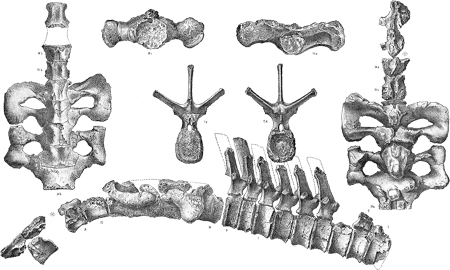 The remains of Agathaumas were found at Black Buttes, 80 km east of Green River, in the Lance Formation (then called the Laramie Formation) of Wyoming by Fielding Bradford Meek and Henry Martyn Bannister while hunting for fossil shells as part of Ferdinand Hayden's Geological Survey of the Territories in 1872. Its discovery between ancient coal seams confirmed a Late Cretaceous age for this formation, rather than a Tertiary age, as long thought.
The holotype consists of 16 vertebrae from the tail, hip and back, some hip bone fragments, and several ribs.
The remains of Agathaumas were found at Black Buttes, 80 km east of Green River, in the Lance Formation (then called the Laramie Formation) of Wyoming by Fielding Bradford Meek and Henry Martyn Bannister while hunting for fossil shells as part of Ferdinand Hayden's Geological Survey of the Territories in 1872. Its discovery between ancient coal seams confirmed a Late Cretaceous age for this formation, rather than a Tertiary age, as long thought.
The holotype consists of 16 vertebrae from the tail, hip and back, some hip bone fragments, and several ribs.


