







Pronunciation: TOR-vo-SOR-us
Meaning: Savage lizard
Author/s: Galton and Jensen (1979)
Synonyms: None known
First Discovery: Colorado, USA
Acta Ordinal: #278
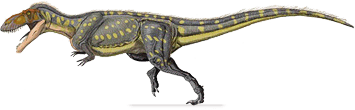
Torvosaurus tanneri
If the parts of Torvosaurus that are missing are of typical megalosaurid-proportion compared to the parts that aren't, it may have been one of the largest genus-certain Jurassic theropods ever known.
It lived at the opposite end of the Morrison Formation to Allosaurus (and its possible synonym Saurophaganax) which bodes well for the "one super predator per ecosystem" theory. But if, somehow, at some point, their paths crossed—who would be the apex predator?
Judging by the fossils in hand, Torvosaurus was heavily built with amazingly powerful arms, and the so-called “moustache bones”—the maxillae—found in Portugal, if scaled like-for-like with the American version, would make its skull almost five and a half feet long! This colossal noggin would have put the European Torvosaurus on a par with Tyrannosaurus rex, and if this is the standard size of all full grown adults of this species it could have dominated anything roaming Western U.S.A. But alas, these remains were downsized to a more modest size in 2014 as they became a second species of Torvosaurus— Torvosaurus gurneyi. Though at an estimated length of 10 meters and a couple of tons in weight, it's still the largest theropod dinosaur known from Europe.
Some believe that this particular Savage lizard may have a couple of synonyms-in-waiting floating around the megalosaurid family tree in the form of middle Morrison contemporaries Edmarka rex and "Brontoraptor"—the unofficial but catchy "Thunder plunderer", but may have bona fide fossils hidden away in museum collections, unbeknownst to their curators.
Remains that were discovered by Elmer Riggs way back in 1899 and stored undescribed at Chicago's Field Museum of Natural History were officially assigned to Torvosaurus in 2014 by Michael Hanson and Peter Makovicky, who suspect other Torvosaurus material may lay unprepared in such institutions. Also, a partial skeleton discovered in Westphalia, Germany, and nicknamed "the Monster of Minden" (Das Monster von Minden), but currently undescribed, may turn out to be a Torvosaurus-like megalosaurid, if not a specimen of Torvosaurus itself.
Judging by the fossils in hand, Torvosaurus was heavily built with amazingly powerful arms, and the so-called “moustache bones”—the maxillae—found in Portugal, if scaled like-for-like with the American version, would make its skull almost five and a half feet long! This colossal noggin would have put the European Torvosaurus on a par with Tyrannosaurus rex, and if this is the standard size of all full grown adults of this species it could have dominated anything roaming Western U.S.A. But alas, these remains were downsized to a more modest size in 2014 as they became a second species of Torvosaurus— Torvosaurus gurneyi. Though at an estimated length of 10 meters and a couple of tons in weight, it's still the largest theropod dinosaur known from Europe.
Some believe that this particular Savage lizard may have a couple of synonyms-in-waiting floating around the megalosaurid family tree in the form of middle Morrison contemporaries Edmarka rex and "Brontoraptor"—the unofficial but catchy "Thunder plunderer", but may have bona fide fossils hidden away in museum collections, unbeknownst to their curators.
Remains that were discovered by Elmer Riggs way back in 1899 and stored undescribed at Chicago's Field Museum of Natural History were officially assigned to Torvosaurus in 2014 by Michael Hanson and Peter Makovicky, who suspect other Torvosaurus material may lay unprepared in such institutions. Also, a partial skeleton discovered in Westphalia, Germany, and nicknamed "the Monster of Minden" (Das Monster von Minden), but currently undescribed, may turn out to be a Torvosaurus-like megalosaurid, if not a specimen of Torvosaurus itself.
(Tanner's savage lizard)Etymology
Torvosaurus is derived from the Latin "torvus" (savage) and the Greek "sauros" (lizard), named for its carnivorous nature and large size.
The species epithet, tanneri, is named in honour of Nathan Eldon Tanner, first counselor in the First Presidency of The Church of Jesus Christ of Latter-day Saints. We have no idea why. ZooBank registry: urn:lsid:zoobank.org:act:08689E74-02E6-4753-9A22-8BF60A85BA39. The species epithet, gurneyi, honours paleoartist James Gurney.
Discovery
The first fossils of Torvosaurus tanneri were discovered at Dry Mesa Quarry in the Brushy Basin Member of Colorado's Morrison Formation by James A. Jensen and Kenneth Stadtman in 1972.
The holotype (BYU 2002) includes an upper arm bone (humerus) and lower arm bones (radius and ulna). Additional material includes some skull bones, back bones, hip bones and 'hand' bones.
The first fossils of Torvosaurus gurneyi were found in the Porto Novo-Amoreira Member of the Lourinhã Formation, Cliffs of Praia da Vermelha, Lourinhã, Portugal. The holotype (ML 1100) is an incomplete left maxilla (tooth-bearing bone of the upper jaw) with one protruding tooth.


