









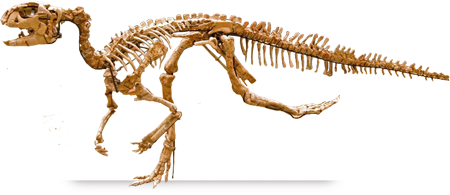
Pronunciation: kon-VOH-lo-SOR-us
Meaning: Flocking lizard
Author/s: Andrzejewski et al. (2019)
Synonyms: None known
First Discovery: Texas, USA
Acta Ordinal: #1017
Convolosaurus marri
Convolosaurus marri is a small ornithopod dinosaur from the Early Cretaceous Twin Mountains Formation of north-central Texas, known from an exceptional bonebed discovered at Proctor Lake. The site preserves hundreds of bones representing at least twenty-nine individuals ranging from small juveniles to near-adults, yet notably lacks even the faintest whiff of a bona-fide adult fossil, providing one of the richest snapshots of early ornithopod growth and possible social behavior in North America.
The abundance of similarly sized animals found together has been interpreted as evidence of group living—a hypothesis reflected in its name, which derives from the Latin convolare, "to flock together".
An agile, beaked herbivore roughly 2–3 meters long, Convolosaurus shows the narrow snout and leaf-shaped teeth, and lightly built limbs with five-fingered hands and four-toed feet typical of basal ornithopods, and represents an early stage on the ornithopod stem leading toward the larger, more specialized iguanodontians of the mid-Cretaceous.
An agile, beaked herbivore roughly 2–3 meters long, Convolosaurus shows the narrow snout and leaf-shaped teeth, and lightly built limbs with five-fingered hands and four-toed feet typical of basal ornithopods, and represents an early stage on the ornithopod stem leading toward the larger, more specialized iguanodontians of the mid-Cretaceous.
(Marr's Flocking Lizard)Etymology
Convolosaurus is derived from the Latin "convolare" (to flock together) and the Greek "sauros" (lizard), referring to clusters of juvenile specimens found together at the dig site.
The species epithet, marri (MAH-rye), honours Dr. Ray H. Marr who produced the Society of Vertebrate Paleontology videos "We are SVP" and "About the SVP Logo" posted on the SVP website (vertpaleo.org), and who is a strong proponent of students at Southern Methodist University (SMU).
ZooBank registry: urn:lsid:zoobank.org:act:468990B8-F35E-4165-8065-9FE0DA581D8A.
Discovery
The first remains of Convolosaurus were discovered in the Twin Mountains Formation (Trinity Group) at Proctor Lake, Comanche County, Texas, USA, by James "Rusty" Branch in May 1985.
The holotype (SMU 72834) is a skull and partial articulated skeleton with 9 neck vertebrae, 15 back vertebrae, 6 hip vertebrae, 23 tail vertebrae, partial shoulder girdles, a left arm and partial left hand, partial right upper arm, pelvic girdle, parts of both thighs and shins, and a partial left calf.
As of 2019, at least 29 individuals from "Camp Quarry" and "North Quarry" along the southeast shores of Proctor Lake (totalling 488 specimens and 48 localities) have been referred to Convolosaurus. While the holotype is the largest among them, measuring approximately 2.5-3 m in length, it does not represent a full grown adult.
All material is curated at the Shuler Museum of Paleontology at Southern Methodist University (SMU) in Dallas, Texas, except for the following specimens: SMU 70456 (on display at the Proctor Lake US Army Corps of Engineers Office in Proctor, Texas), SMU 74087, 74093, and 74104 (a composite skeleton on display at the Perot Museum of Nature and Science in Dallas, Texas), and SMU 74663 (a composite skeleton on display at the Fort Worth Museum of Science and History in Fort Worth, Texas).
Preparators
R. Beauford, W.D. Downs, A. Konnerth, D. Muldunado, K.D. Newman, V. Yarborough, et al.


