




Pronunciation: ISS-key-o-SEH-ruh-tops
Meaning: Ischium horned face
Author/s: He, Makovicky, Wang, et al. (2015)
Synonyms: None known
First Discovery: Shandong Province, China
Acta Ordinal: #924
Ischioceratops zhuchengensis
Ischioceratops is a member of Leptoceratopsidae, a subfamily amongst the frilled and horn-faced herbivores known as ceratopsians. Funnily enough, leptoceratopsids lack horned faces and sport only the faintest whiff of a frill, but they do possess very robust jaws equipped with highly specialised large teeth, probably for dealing with tough vegetation.
Behind Zhuchengceratops inexpectus, Ischioceratops is the second leptoceratopsid from the Kugou locality of Zhucheng's Wangshi Group, which could be glorious news, but also not. Although lauded as choc-o-bloc with unique features of its hip, Ischioceratops currently lacks any parts that are directly comparable to the known fossils of Zhuchengceratops. So if a specimen turns up in the same area that marries the "unique" features of both critters, then the former will be sunk as a junior synonym because the latter was named first.
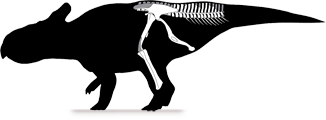
Ischioceratops has nine hip vertebrae, which is more than the going rate of 6-8 for basal (non-ceratopsid) ceratopsians but one less than found in advanced ceratopsids. The ischium bone of its hip is unique among known dinosaurs in being robust and shaped somewhat like an archer's bow, which flares from both ends towards the midpoint, forming what would be the bow handle. That raised and thickened area, called the "Obturator process", sports an oval pit that serves as an anchor point for the thigh muscle. The bottom end of its ischial "bow" has an axehead-shaped bony expansion.
Behind Zhuchengceratops inexpectus, Ischioceratops is the second leptoceratopsid from the Kugou locality of Zhucheng's Wangshi Group, which could be glorious news, but also not. Although lauded as choc-o-bloc with unique features of its hip, Ischioceratops currently lacks any parts that are directly comparable to the known fossils of Zhuchengceratops. So if a specimen turns up in the same area that marries the "unique" features of both critters, then the former will be sunk as a junior synonym because the latter was named first.
Ischioceratops has nine hip vertebrae, which is more than the going rate of 6-8 for basal (non-ceratopsid) ceratopsians but one less than found in advanced ceratopsids. The ischium bone of its hip is unique among known dinosaurs in being robust and shaped somewhat like an archer's bow, which flares from both ends towards the midpoint, forming what would be the bow handle. That raised and thickened area, called the "Obturator process", sports an oval pit that serves as an anchor point for the thigh muscle. The bottom end of its ischial "bow" has an axehead-shaped bony expansion.
(Ischium horned face from Zhucheng)Etymology
Ischioceratops is derived from "ischium" (a hip bone, the features of which are unique in Ischioceratops) and the Greek "ceras" (horned) and "-ops" (face). The species epithet, zhuchengensis, means "from Zhucheng" in Latin. ZooBank registry: urn:lsid:zoobank.org:act:C8B090D0-263A-422A-8A4D-7AB22496B22F.
Discovery
The remains of Ischioceratops were discovered at Kugou Quarry in the Xingezhuang Formation (Wangshi Group), Zhucheng, Shandong Province, China, and excavated in 2008.
The holotype (ZCDM V0016) is an incomplete, partially articulated specimen, comprising the entire sacrum (a block of fused hip vertebrae), a few tendons, both halves of the pelvis, a series of fifteen tail vertebrae, and the right thigh, shin and calf.
Preparators
He Sicai, Xiang Lishi and Yu Tao.


