




Pronunciation: LOW-kee-SEH-ruh-tops
Meaning: Loki's horned face
Author/s: Loewen et al. (2024)
Synonyms: None known
First Discovery: Montana, USA
Acta Ordinal: #1164
Lokiceratops rangiformis
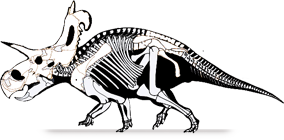
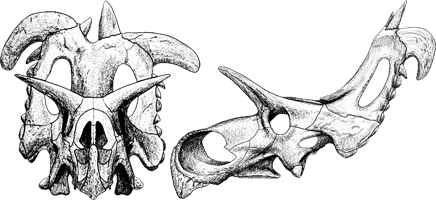
Centrosaurines are a branch of horned dinosaurs renowned for the theatricality of their skulls—typically short brow horns, frills that bristle with spikes, hooks, and other expressive ornamentation, and an eclectic assortment of weird nasal protuberances that range from towering horns to flattened bosses to, in some cases, nothing at all. They’re the showier cousins to the long-frilled chasmosaurines, trading sweeping shields for compact but highly decorated headgear. Into this lineage of visual excess steps Lokiceratops rangiformis, whose curling, asymmetrical frill spikes seem to push centrosaurine ornamentation into even stranger territory. Those sweeping spikes give the animal a silhouette unlike any other known ceratopsid. Except it is like another. Several others, in fact. A number of researchers have suggested that the differences among Lokiceratops, Albertaceratops, and Medusaceratops might reflect evolving ornamentation within a single species—variation tied to age, sex, or individual identity—rather than a suite of distinct taxa, creating a mischievously appropriate interpretive tangle for a dinosaur named after a trickster god.
(Loki’s horned face that looks like a caribou)Etymology
Lokiceratops is derived from "Loki" (the Norse trickster god), and the Greek "keras" (horned) and "ops" (face), in reference to the similarity of its horns to the curved blades associated with Loki.The species epithet, rangiformis, is derived from "Rangifer" (the scientific name for reindeer or caribou, whose antlers are asymmetrical) and the Latin "formis" (shape), referring to the similarly asymetrical skull ornamentations of Lokiceratops. ZooBank registry: urn:lsid:zoobank.org:act:548AA668-EE62-49DA-8CA2-939A00223B92.
Discovery
 The remains of Lokiceratops were discovered in the McClelland Ferry Member of the Judith River Formation, at "Loki Quarry" on Wolery Ranch, Kennedy Coulee, north of the town of Rudyard, Hill County, Montana, USA, by Mark Eatman in the late spring of 2019.
Nicknamed "Frederik", the holotype (EMK 0012) includes a skull minus the lower jaws, a neck vertebra, the right shoulder girdle, pelvic elememts (both ischia and the sacrum), one tail vertebra and a chevron.
Preparators
Brock Sisson, founder of Fossilogic LLC in Pleasant Grove, Utah.


