




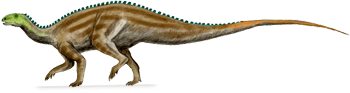
Pronunciation: teh-NON-toe-SOR-us
Meaning: Tendon lizard
Author/s: John Ostrom (1970)
Synonyms: None known
First Discovery: Montana, USA
Acta Ordinal: #228
Tenontosaurus tilletti
Despite its size, seven meters long and a ton in weight, Tenontosaurus had two glaring weaknesses: like many herbivorous dinosaurs, it was likely as dim as a miner's boot, and like most if not all ornithopods, it lacked any form of protective armour. But was it a sitting duck, or a sitting duck-billed dinosaur? Was it even a duck-billed dinosaur? Well... no, no, and no.
Tenontosaurus was originally assigned to Hypsilophodontidae, a family of herbivorous dinosaurs which has been disbanded (no point having a "family" with only one member: Hypsilophodon), so it now loiters at the foot of Iguanodontia as one of its most primitive members. Its fossils were first discovered by an AMNH expedition to Big Horn County in 1903, but despite a colossal haul of remains during the 1930s, they weren't afforded much attention until John Ostrom of Yale's Peabody Museum established a full-time dig site at the Big Horn Basin in the 1960s and officially named Tenontosaurus in 1970.
Tenontosaurus appears to have been a favourite prey of Deinonychus, or at least its scavenge-meat of choice, as the pack-hunting raptor’s teeth have been found alongside 20% of all known Tenontosaurus remains—compared to virtually none of the same area's other herbivores. It’s a bit unfortunate that this unassuming quadrupedal plant muncher gained fame through what ate it, rather than through an array of star-spangled characteristics of its own. Although it does have one rather large, unique feature...
At almost the same length as the rest of its body, and one of the largest relative to body size among all known dinosaurs, the tail of Tenontosaurus was thick and deep, requiring a series of heavyweight tendons just to keep it off the floor. In theory, it could have dealt a knockout blow if executed with anything resembling precision, and this was their only form of defence, barring "safety in numbers".
Tenontosaurus were the cows of the Cretaceous, relentlessly moving in herds to find fodder for their huge batteries of teeth, and if the weak, injured or old became tail-end-Charlies and easy prey for predators—tough luck. That may sound heartless, but it ensured survival of the fittest, and if you were a herbivore during the Early Cretaceous, you needed to be fit—no matter how big you, or your tail, were.
Tenontosaurus is derived from the Greek "ténontas" (tendon) and "sauros" (lizard") in reference to the system of stiffening tendons in its back and tail.
Barnum Brown unofficially named "Tenantosaurus" (with an "a") in the 1930's but it didn't receive its official name, "Tenontosaurus (with an "o"), until a full description by John Ostrom in 1970.Tenontosaurus was originally assigned to Hypsilophodontidae, a family of herbivorous dinosaurs which has been disbanded (no point having a "family" with only one member: Hypsilophodon), so it now loiters at the foot of Iguanodontia as one of its most primitive members. Its fossils were first discovered by an AMNH expedition to Big Horn County in 1903, but despite a colossal haul of remains during the 1930s, they weren't afforded much attention until John Ostrom of Yale's Peabody Museum established a full-time dig site at the Big Horn Basin in the 1960s and officially named Tenontosaurus in 1970.
Tenontosaurus appears to have been a favourite prey of Deinonychus, or at least its scavenge-meat of choice, as the pack-hunting raptor’s teeth have been found alongside 20% of all known Tenontosaurus remains—compared to virtually none of the same area's other herbivores. It’s a bit unfortunate that this unassuming quadrupedal plant muncher gained fame through what ate it, rather than through an array of star-spangled characteristics of its own. Although it does have one rather large, unique feature...
At almost the same length as the rest of its body, and one of the largest relative to body size among all known dinosaurs, the tail of Tenontosaurus was thick and deep, requiring a series of heavyweight tendons just to keep it off the floor. In theory, it could have dealt a knockout blow if executed with anything resembling precision, and this was their only form of defence, barring "safety in numbers".
Tenontosaurus were the cows of the Cretaceous, relentlessly moving in herds to find fodder for their huge batteries of teeth, and if the weak, injured or old became tail-end-Charlies and easy prey for predators—tough luck. That may sound heartless, but it ensured survival of the fittest, and if you were a herbivore during the Early Cretaceous, you needed to be fit—no matter how big you, or your tail, were.
The species epithet, tilletti, honors the Lloyd Tillet family of Lovell, Wyoming. George Olshevsky pleaded with the ICZN to have this epithet changed to the correct "tilletorum" (it honors a family and plural endings are "-orum", singular are "-i") but to no avail.
Discovery
The first remains of Tenontosaurus were found in the Himes Member of the Cloverly Formation, Wheatland County, Montana, USA, by a Barnum Brown-led American Museum of Natural History (AMNH) expedition in 1903. The holotype (AMNH 3040) is a partial skeleton, lacking the skull and forelimbs. More discoveries were made in the 1930s, 1940s and 1960s.
 • Nudds JR, Lomax DR and Tennant JP (11 August 2022) "Gastroliths and Deinonychus teeth associated with a skeleton of Tenontosaurus from the Cloverly Formation (Lower Cretaceous), Montana, USA".


