








Pronunciation: dee-AB-lo-SEH-ruh-tops
Meaning: Devil's horned face
Author/s: Kirkland and DeBlieux (2010)
Synonyms: None known
First Discovery: Utah, USA
Acta Ordinal: #710
Diabloceratops eatoni
The first remnant of what would become Diabloceratops was tagged "the Nipple Butte skull" after being discovered by Josh Smith protruding from the lower sandstone member on the south end of the Kaiparowits Plateau in 1998. Despite the significance of the find, a strict "no off-road driving" law was in place and, being discovered off-road, its removal involved sledging it to the nearest road on the up-turned roof of a Ford Mustang!
Another skull was discovered near Last Chance Creek in the middle of the middle mudstone member of the Wahweap Formation in 2002, but its extraction lacked the raw passion of the original and involved gas-powered cutoff saws and helicopters, but at least it was diognostic and that's what counts.
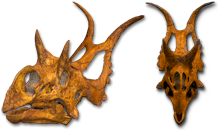
The "Last Chance skull" represents the first diagnostic later than Late Campanian centrosaurine ever discovered south of Montana and is a good meter long from the beak to the back of its frill, where a pair of spectacular curved spines take over and add another half meter to its total length. Despite a relatively slim, somewhat tapered, and outrageously flamboyant frill, the skull to which it is attached is deeper and shorter than any hitherto known centrosaurine, and the whole thing looks like some kind of primitive field-ploughing contraption when viewed from above.
The "Last Chance skull" represents the first diagnostic later than Late Campanian centrosaurine ever discovered south of Montana and is a good meter long from the beak to the back of its frill, where a pair of spectacular curved spines take over and add another half meter to its total length. Despite a relatively slim, somewhat tapered, and outrageously flamboyant frill, the skull to which it is attached is deeper and shorter than any hitherto known centrosaurine, and the whole thing looks like some kind of primitive field-ploughing contraption when viewed from above.
(Eaton's Devil Horned Face)Etymology
Suggested by Scott Hartman, Diabloceratops is derived from the Spanish "Diablo" (devil), in reference to the "devilish horns" on the top of its frill, and the Greek "ceras" (horn) and "ops" (face).
The species epithet, eatoni (ee-TOH-ni), both honours Jeffery G. Eaton—a palaeontologist at Weber State University and long-time friend of lead author Jim Kirkland—for his role in establishing Grand Staircase-Escalante National Monument where the specimen was found and gives him a playful dig in the ribs for favouring the study of extinct mammals over dinosaurs.
Discovery
Diabloceratops was discovered in the Wahweap Formation of Grand Staircase-Escalante National Monument, southern Utah, USA, by Don DeBlieux in 2002.The holotype (UMNH VP 16699) is the "Last Chance skull" - all of the right side and part of the left, housed at the Utah University Museum of Natural History.


