






Pronunciation: AHN-zoo
Meaning: Demon bird
Author/s: Lamanna et al. (2014)
Synonyms: None known
First Discovery: Dakota, USA
Acta Ordinal: #873
Anzu wyliei
Named after a bird-like demon from Mesopotamian mythology and affectionately referred to as "the chicken from hell", Anzu was discovered in the aptly-named Hell Creek Formation and is North America's most complete and largest known oviraptorosaur. But it's also one of the youngest, as it lived during the latest Maastrichtian, right at the end of the age of dinosaurs.
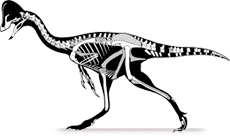
Specifically a caenagnathid oviraptorosaur, Anzu is known from four specimens which together account for 80% of a skeleton, one of which has a broken and healed rib and another a damaged toe, which is no surprise, bearing in mind they shared their eco-system with Tyrannosaurus rex. What is surprising, however, is that two groups of scientists from two different museums were simultaneously studying specimens of Anzu found at separate quarries in North and South Dakota, blissfully unaware of each other's work until they met at a Society of Vertebrate Paleontology conference in 2005. After which, they pooled their fossils and took eight years to think of a name.
Caenagnathidae — the group of casque-topped critters to which Anzu belongs — was coined by Sternberg in 1940 but has remained mysterious due in no small part to the fragmentary remains of its members. Being so well represented, Anzu afforded palaeontologists their first good look at the evolutionary relationships and anatomy of these enigmatic "egg snatchers", which not only confirmed Microvenator and Gigantoraptor as basal members of the group but also hinted that caenagnathids were ecological generalists that fed upon vegetation, small cowering critters, and anything else they could lay their robust beaks on.
Specifically a caenagnathid oviraptorosaur, Anzu is known from four specimens which together account for 80% of a skeleton, one of which has a broken and healed rib and another a damaged toe, which is no surprise, bearing in mind they shared their eco-system with Tyrannosaurus rex. What is surprising, however, is that two groups of scientists from two different museums were simultaneously studying specimens of Anzu found at separate quarries in North and South Dakota, blissfully unaware of each other's work until they met at a Society of Vertebrate Paleontology conference in 2005. After which, they pooled their fossils and took eight years to think of a name.
Caenagnathidae — the group of casque-topped critters to which Anzu belongs — was coined by Sternberg in 1940 but has remained mysterious due in no small part to the fragmentary remains of its members. Being so well represented, Anzu afforded palaeontologists their first good look at the evolutionary relationships and anatomy of these enigmatic "egg snatchers", which not only confirmed Microvenator and Gigantoraptor as basal members of the group but also hinted that caenagnathids were ecological generalists that fed upon vegetation, small cowering critters, and anything else they could lay their robust beaks on.
(Wylie's Demon Bird)Etymology
Anzu is the namesake of Anzu (aka Imdugud), a bird-like demon or "storm bird" from Mesopotamian mythology who is most famous for steeling Enlil's tablets of destiny. Understandibly miffed, Ea and Belet-Ili conceived the war god Ninurta especially to retrieve said tablets and Anzu was killed in the process. That's one version of events, anyway.
The species epithet, wyliei, is named after Mr. Wylie J. Tuttle, the dinosaur-loving grandson of Mr. and Mrs. Lee B. Foster, in recognition of their generous support of Pittsburgh's Carnegie Museum. ZooBank registry: urn:lsid:zoobank.org:act:B4E094D2-8081-452E-8976-DB96DA97308D.
Discovery
The first remains of Anzu were discovered in the uppermost level of the Hell Creek Formation, Harding County, South Dakota, USA, by Fred Nuss (of Nuss Fossils) in November 1998, during his honeymoon with new bride Candace. The holotype (CM 78000) is a partial skeleton.
A second specimen (CM 78001) was discovered by Robert Detrich less than 100m away, a third (FMNH PR 2296, formerly BHM 2033) is from the same general area, and a fourth (MRF 319) was found in the same rock Formation, 5 km northwest of the town of Marmarth, Slope County, North Dakota, by Scott Haire.
Preparators
Triebold Paleontology, Inc. (CM 78000 and CM 78001), Barbara Benty, Stephen Begin, and William Wagner (MRF 319).


